If you are a professional in the technology sector who has progressed beyond entry-level and early-career roles but has not yet reached the most senior or executive (C-suite) positions, you most likely search for a relevant digital technology leadership program to stay competitive and transition to higher leadership.
Or, as it happened to many of our community members, one day, you just woke up to the role of a Chief Technology Officer, now what? You have all this technical knowledge, but don’t fully grasp the concepts of aligning technology strategy with overarching business goals, technical debt, managing internal and external stakeholders, negotiations, cross-functional C-level collaboration, handling the Board and the CEO, and the list goes on.
The only way forward is the relevant executive education delivered in a way that doesn’t affect or pause your career.
So your biggest challenge now is identifying the technology leadership program that best fits your personal and professional preferences and, more importantly, short- and long-term career goals.
In this guide, we explain the three general categories of digital technology leadership programs to provide you with vital information that will help you make the final choice.
Now, every tech leader has a different motivation. Some chase credentials. Some follow corporate ladders. Others just want to lead better. The question you must ask yourself is: Which one are you?
To answer it, you first need to understand the basic disambiguation between technology leadership programs.
3 Main Types of Digital Technology Leadership Programs
Considering their purpose, intent, structure, goals, real-world applicability, and delivery model, we can define the three general types of TLPs:
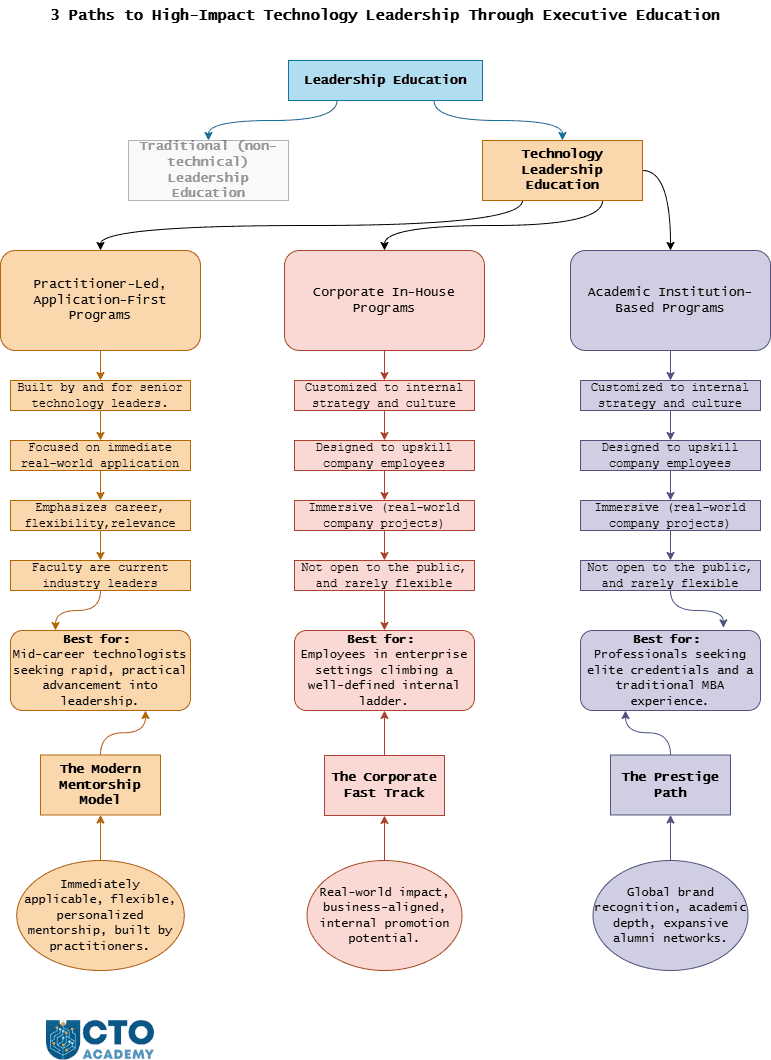
1. Practitioner-Led, Application-First Programs
Examples: CTO Academy’s Digital MBA for Technology Leaders.
These are:
- Built by and for senior technology leaders.
- Focused on immediate real-world application and practical mentoring.
- Emphasize flexibility, global relevance, and career acceleration.
- Faculty are current industry leaders who offer insight from the field, not just textbooks.
Ideal for: Mid-career tech professionals looking to transition into executive roles, seeking relevance over reputation, and mentorship over theory.
2. Academic Institution-Based Programs
Examples: MIT, Wharton, Berkeley, Cambridge.
These are typically:
- Prestige-heavy and theory-rich.
- Often designed with a broad business audience in mind, not specifically tech leadership.
- Delivered via structured cohorts, occasionally remote, sometimes hybrid.
- Focused on academic excellence but can be light on immediacy or real-world application.
- Often fall short for tech leaders.
Ideal for: Executives seeking name-brand credentials and a traditional MBA-like experience.
3. Corporate In-House Programs
Examples: GE’s Management Development Program, IBM’s Extreme Blue leadership program.
These are:
- Highly customized to internal strategy and culture.
- Designed to upskill high-potential employees within the company.
- Often immersive, with real-world company projects.
- Not open to the public, and rarely flexible or transferable externally.
Ideal for: Employees within large enterprises on a defined leadership pipeline.
Why This Disambiguation Matters to You?
Outlining these three categories helps you:
- Understand the landscape of options.
- Realize that not all programs are built the same.
- Recognize that there is a third, modern path—lean, real-world, mentor-led, and built by tech professionals for tech professionals like you.
Here’s a handy infographic that summarizes all of this that you can download:
Now, you’ve heard about institutional programs, maybe even graduated from one. And you have some general understanding of the corporate programs. But what exactly do you know about the modern mentorship model – practitioner-led, application-first programs?
Well, first of all, as the name suggests, there’s a lot more going on than just teaching.
This is what Graham Cooke, Landmarks Support Service’s Head of IT, wrote earlier this month about his experience:
The CTO Academy’s Digital MBA for Technology Leaders has been meticulously planned to maximise value for the students: From the breadth of knowledge and expertise of the lecturers, to the way the course is laid out, you can tell the team has thought really carefully about the student experience. Even down to getting the occasional nudge from the team when life gets in the way and the pace of learning drifts a bit. It is clear that the founders really care that students get maximum bang for their buck.
The course content is regularly reviewed and updated, and the (growing!) global professional community you get access to is incredibly supportive and generous with their time. If you want to deep-dive, there are ample additional learning materials, over and above the 200+ video lectures you get. Not to mention the regular events, including CTO Shadowing online sessions, Expert Q&As, Peer-to-Peer sessions, networking meetups, and more.
I will refer back to this course regularly, and going through the Digital MBA as a technical leader has given me a greater breadth of knowledge and lots of opportunities for reflection and growth.
Above all, this has been an investment in myself – one which I am 100% sure will continue to give an excellent return long after completion.
Graham has been an IT professional since 1999. He has a broad skillset and practical experience at all stages of the software development lifecycle, from both the managerial and technical aspects. But there were still areas that he needed to perfect to become a high-impact technology leader. That’s the reason he chose the modern mentorship model of executive education over an institutional (academic) program. He favors immediate applicability and being taught by someone who has a close understanding of his daily operational challenges and can, thus, guide him through them literally daily.
That’s Graham. Now, let’s see Who You Are, shall we?
Identifying Your Inner Drive
We will now present three personas. Each of these personas is aiming for the same goal, but has a different idea of how to get there. For the most part, individual circumstances — both personal and professional — influence the path. Your job is to carefully review all three and associate yourself with just one, okay?
Let’s go.
Persona A: “I Want to Lead Smarter Now” → The Modern Operator
Driven by: Practical skills, relevance, mentorship, and agility.
“I don’t need prestige—I need tools, insight, and guidance to lead better today.”
Looks for:
- Practitioner-led, remote-first programs.
- Real-world leadership scenarios.
- Mentorship, peer exchange, flexibility.
Persona B: “I Want the Credentials” → The Prestige Seeker
Driven by: Academic validation, global recognition, structured learning.
“I want a name that carries weight on my resume. I’m aiming for a brand that opens doors.”
Looks for:
- Ivy League or top-tier business schools.
- Accredited, traditional MBA formats.
- Structured cohorts and alumni networks.
Persona C: “I Want to Climb Faster Where I Am” → The Corporate Climber
Driven by: Internal growth, organizational loyalty, strategic career moves.
“I’m on the leadership track here. I need a program that aligns with my company’s future.”
Looks for:
- In-house development programs.
- Business-aligned learning.
- Sponsorship by leadership or HR.
If you identify as Persona A, looking for practical skills, relevance, mentorship, and agility, you have come to the right place. It is something we here at CTO Academy can help you with, just like we are helping Graham and others in his cohort, and like we have so far helped over 500 technology leaders worldwide. Take a look.