Generally speaking, the role of a chief technology officer involves strategic management and execution of technology initiatives within an organization. It is, therefore, pivotal in shaping and implementing the technology roadmap while aligning it with the company’s overall goals and vision.
What enables tech leaders to drive innovation, oversee development and infrastructure, ensure data security and foster a culture of technological advancement is not only a deep understanding of emerging technologies and their potential impact but also the people they lead.
(To see what a day in the life of a CTO looks like, check this post.)
4 main CTO roles
Technology Strategy
This role involves formulating and executing a company’s technology strategy to support its overall business objectives by:
- Developing and implementing strategic plans for technology development, adoption and application.
- Identifying emerging technologies and assessing their potential impact on the business.
- Establishing technology standards and guidelines to ensure consistency and compatibility across systems.
- Fostering collaboration between technology and business teams to align technology initiatives with organisational goals.
- Evaluating and prioritising technology investments based on their potential value and return on investment.
Innovation Management
As a rule of thumb, the chief technology officer oversees the management of innovation within the company, driving the exploration and adoption of new technologies and practices.
However, success depends on the effectiveness of these five activities:
- Identifying opportunities for innovation and technological advancements within the organization.
- Fostering a culture of creativity and continuous improvement.
- Collaborating with research and development teams to identify and implement new technologies.
- Facilitating cross-functional collaboration and knowledge sharing to encourage innovative ideas.
- Evaluating and implementing innovation management processes to streamline idea generation and implementation.
Development Oversight
This CTO role focuses on managing the company’s technology development and infrastructure. The job is to ensure that it meets business requirements along with reliability, scalability and security.
To achieve this, chief technology officers:
- Develop and maintain technology strategy and roadmap.
- Oversee the design, deployment and maintenance of the development.
- Implement robust development processes.
- Stay informed about industry best practices and emerging technologies.
Talent Acquisition & Leadership
As we are waging a full-blown war for talent, chief technology officers are now also responsible for:
- Recruiting and hiring skilled technology professionals aligned with the company’s needs.
- Providing mentorship and professional development opportunities for technology teams.
- Fostering a positive and inclusive work environment that encourages collaboration and innovation.
- Identifying and addressing skills gaps through training and development initiatives.
- Establishing career progression frameworks and performance evaluation processes for technology teams. (see https://sfia-online.org/en)
What is the role of a chief technology officer considering the size of a company?
Job description, average salary and responsibilities certainly differ depending on the company’s size. So let’s take a quick view of some of these basic differences.
CTO job in start-up businesses
Chief technology officer typically focuses on the strategic and technical aspects of technology. Their role involves overseeing the development and implementation of technology solutions aligned with the company’s goals. The chief technical officer is, therefore, responsible for identifying emerging technologies, managing the technology infrastructure and driving innovation within the organisation.
That being said, in start-up businesses, the role of a CTO may vary depending on the company’s size, structure and industry. But generally speaking, their role often involves a hands-on approach. Plus, they wear multiple hats and work closely with low-level team leaders and project managers to deliver technology solutions that meet the business’s needs.
Some of the key responsibilities in start-up businesses include:
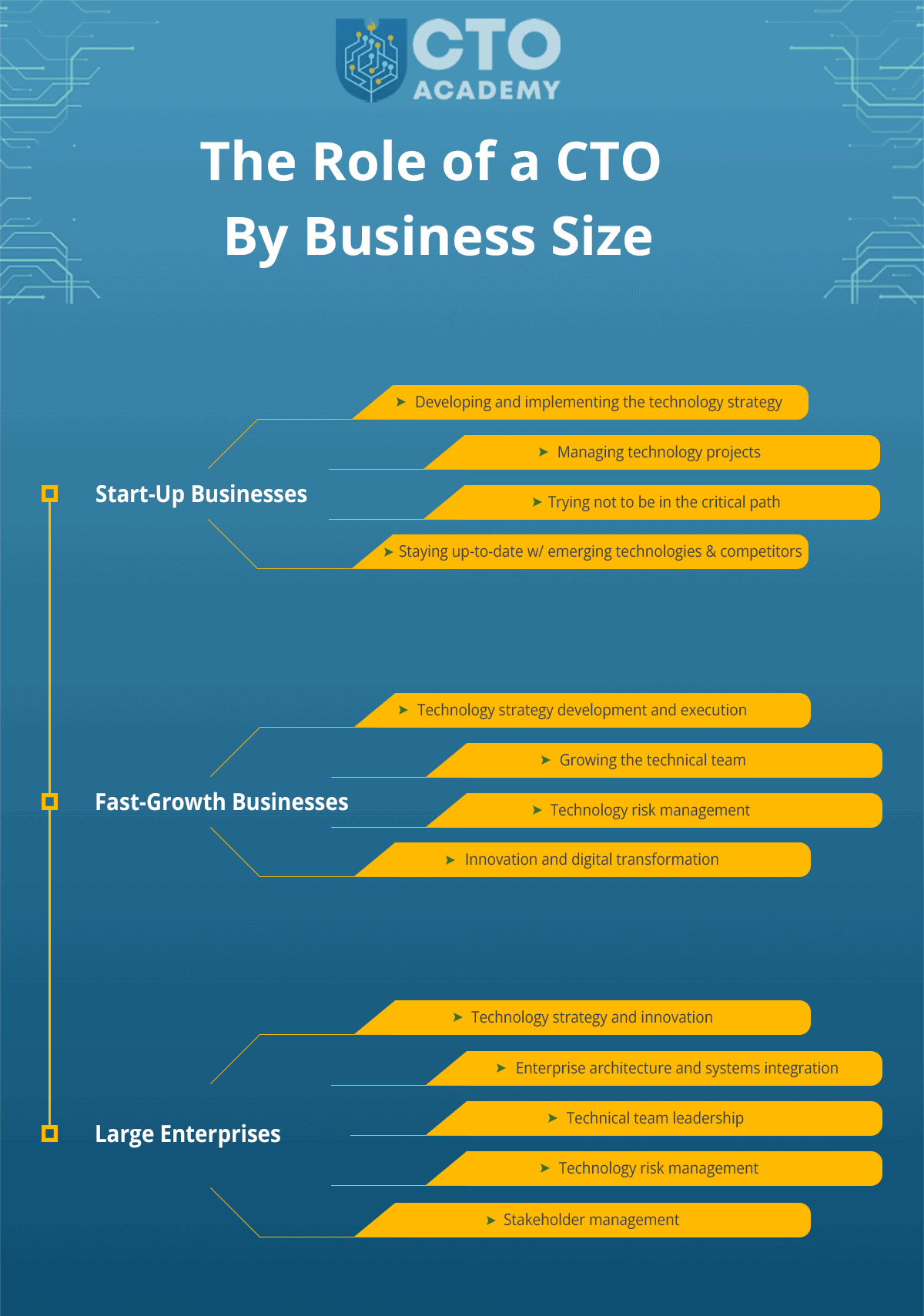
- Developing and implementing the technology strategy
This implies a deep understanding of the company’s current technology landscape and future needs because CTOs should be able to develop and implement a technology roadmap that aligns with the business strategy.
- Managing technology projects
As the leader of the technology team, the CTO oversees the delivery of technology projects, ensuring that they are completed on time, within budget and meet quality standards.
- Trying not to be on the critical path
Most start-up CTOs are still hands-on with the development. They need to be careful not to be in the critical path otherwise they will not have time to oversee everything else under their remit.
- Staying up-to-date with emerging technologies and competitors
Start-up businesses often operate in highly competitive markets. Hence, the CTO should stay abreast of emerging technologies and assess their potential impact on the business.
In fast-growth businesses
Here, duties expand to include a combination of strategic and operational responsibilities. The role is significantly more complex than in start-up businesses, as the organisation’s needs and challenges rapidly evolve.
Tech leaders are, therefore, responsible for developing and executing the technology roadmap, managing the technology development and growing infrastructure, overseeing software development and fostering innovation within the organisation. They also closely collaborate with other business units to ensure technology solutions meet the company’s needs. This, in turn, enables the company to scale and grow efficiently.
Key responsibilities include
- Technology strategy development and execution
The CTO develops and executes a technology roadmap that aligns with the company’s business objectives, ensuring that technology investments support growth, productivity and profitability.
- Growing the technical team
A tech leader is responsible for recruiting, managing and retaining top technology talent to ensure that the company has the skills it needs to grow. In other words, leading and motivating the technology team and developing a high-performance culture that fosters creativity, collaboration, and continuous learning.
- Technology risk management
In fast-growth businesses, CTOs have to ensure that technology investments are scalable with the growing demands of the business. So one part of their job is to develop more structured plans to mitigate technology-related risks and ensure business continuity.
- Innovation and digital transformation
The CTO identifies new opportunities and innovative solutions that can transform the business and keep it ahead of the competition. This may involve developing new products or services, implementing new technologies or processes, or leveraging data and analytics to improve decision-making.
Finally, in large enterprises
In large enterprises, the chief technology officer plays a crucial role in shaping the organization’s technology strategy, managing large-scale technology initiatives and ensuring that technology investments support business objectives. As you can imagine, the role is complex and challenging, as they are responsible for managing multiple technology teams and navigating complex business and regulatory environments.
Key responsibilities:
- Technology strategy and innovation
CTOs develop and implement a comprehensive technology strategy that aligns with the organization’s overall business objectives. This includes identifying emerging technologies and innovation opportunities that can drive growth and competitive advantage on a much greater scale than is the case with small and fast-growth businesses.
- Enterprise architecture and systems integration
The CTO oversees the design and implementation of the enterprise architecture, ensuring that systems and applications are integrated and optimized for performance and scalability.
- Technical team leadership
Unlike small and fast-growth companies where a tech leader is leading a team, in large enterprises, the CTO is managing and motivating multiple technology teams, ensuring that they have the resources and support they need to deliver on strategic objectives. They must also develop talent management strategies to attract, develop and retain top technology talent.
- Technology risk management
Here, we discuss cybersecurity threats, regulatory compliance, and data privacy. That implies the development and implementation of risk management plans to mitigate potential threats and ensure business continuity.
- Stakeholder management
As a CTO in a large enterprise, you work closely with senior executives, business leaders and technology vendors to ensure that technology investments support the organization’s overall business objectives.
CTO plays a critical role in large enterprises, leading technology strategy, managing complex initiatives and ensuring that technology investments support business growth and profitability.
Aspiring CTOs should, therefore, focus on developing strong technical and leadership skills, business acumen and the ability to navigate complex business environments.
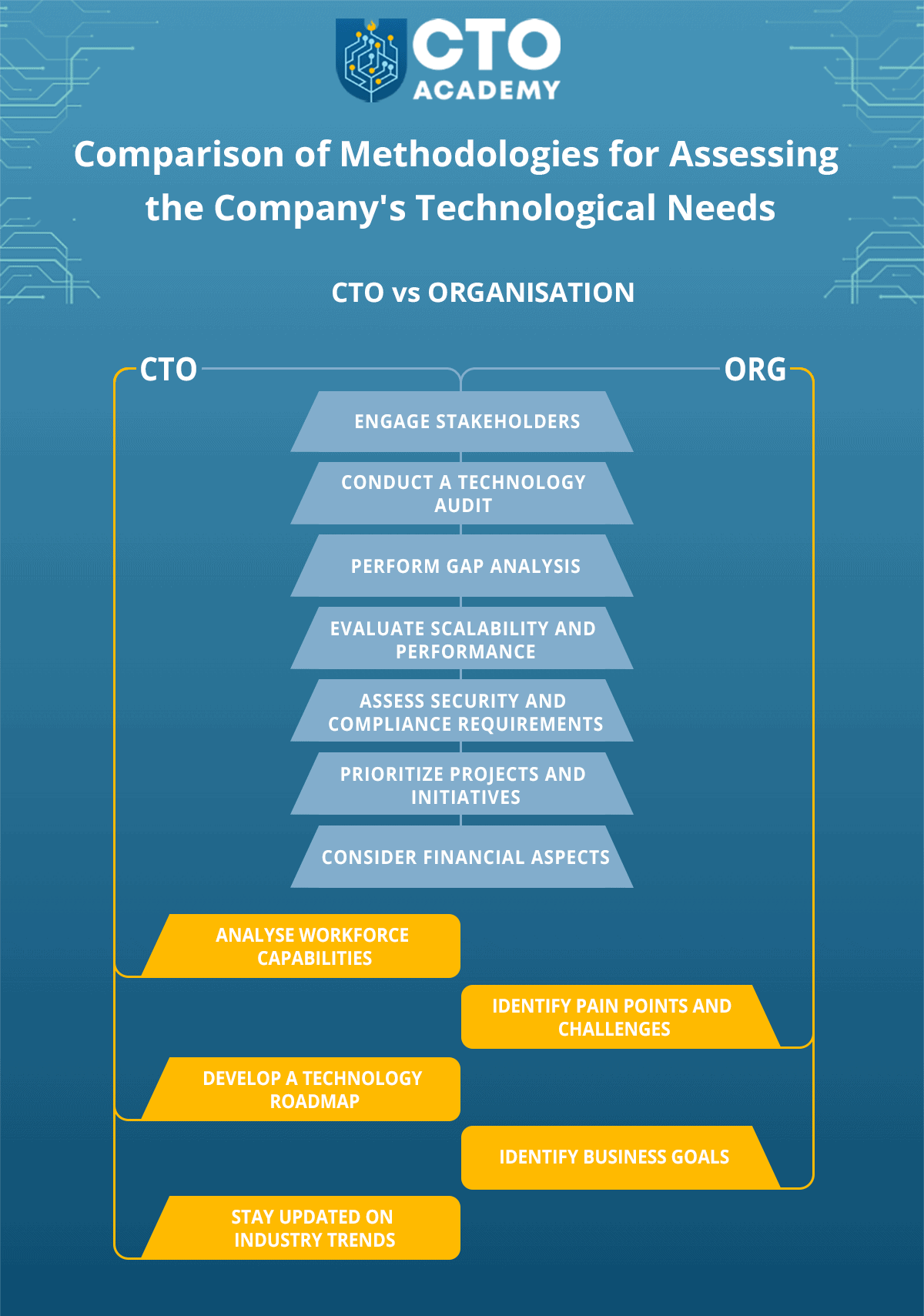
How CTOs and organisations assess technology needs?
Summary
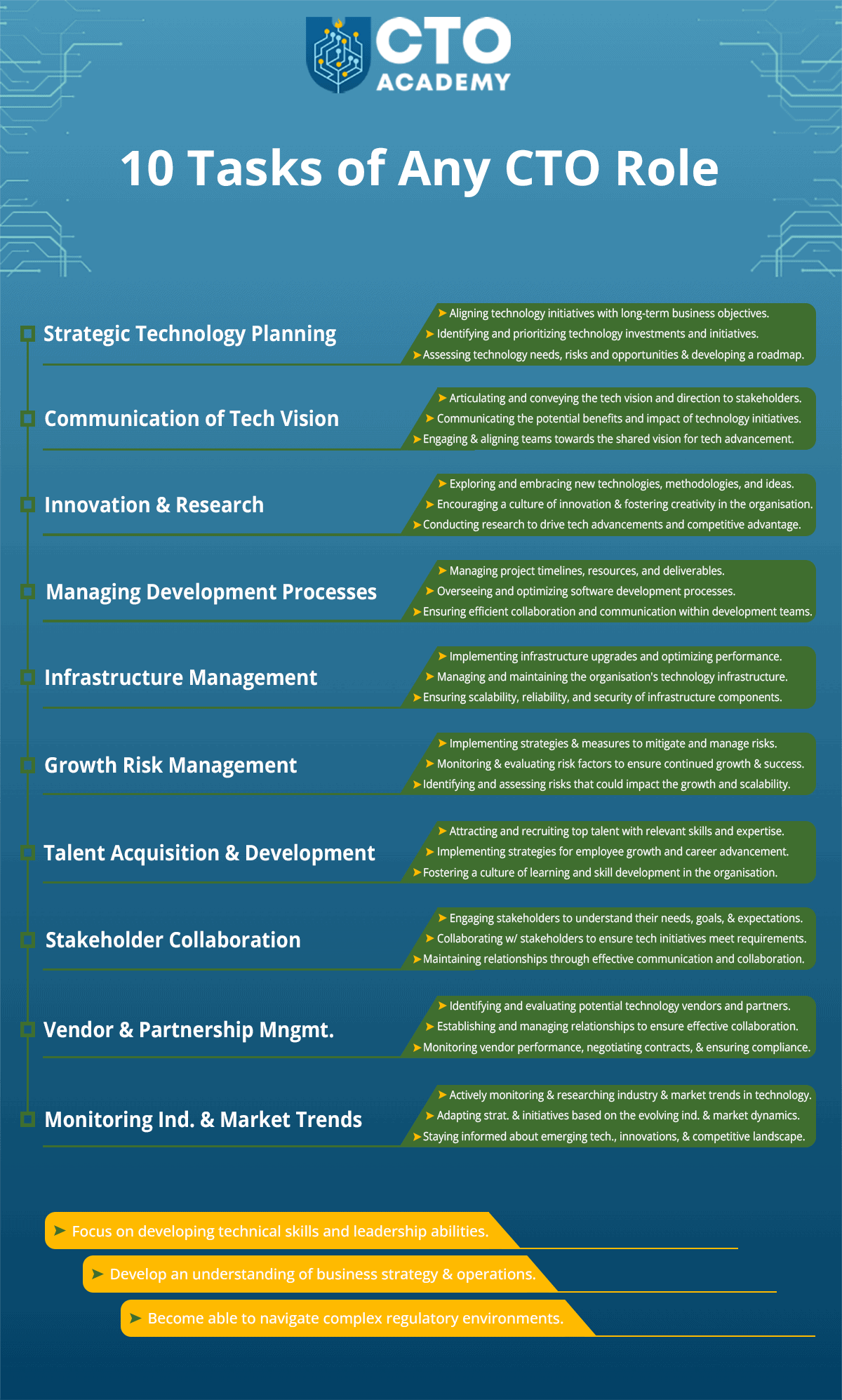
When we consider everything we’ve talked about so far, we come down to 10 common tasks regardless of the size of the organisation or its structure:
- Strategic technology planning
- Communication of tech vision
- Innovation and research
- Managing development processes
- Infrastructure management
- Growth risk management
- Talent acquisition and development
- Stakeholder collaboration
- Vendor and partnership management
- Monitoring industry and market trends
It’s clear then that aspiring tech leaders who are currently working as software developers, product managers, or low-level team leaders should focus on developing their technical skills and leadership abilities. They should also develop an understanding of business strategy and operations, as well as the ability to navigate complex regulatory environments.
It is, after all, a challenge to manage large-scale technology initiatives, balance technical and business priorities and adapt to rapidly changing technologies and business environments.
Conclusion
Considering the job outlook with a steady 16% upward trend until 2031, it is vital for aspiring tech leaders to further improve their management skills. The job market today requires sharp CTO skills that go beyond mere product development and low-level team leading.
The role of a chief technology officer expands with every new technology we introduce to the market. That’s the reason why employers are searching for an array of backgrounds to cover the growing needs.
Hence, to remain competitive in the job market over the next five years, consider these few universal requirements:
6 universal requirements of a CTO role
- A strong educational foundation; i.e., a bachelor’s or master’s degree in computer science, engineering, or a related field.
- Tendencies for continuous learning and staying up-to-date with the latest technological advancements proven by certifications and courses.
- A demonstration of strong leadership and strategic thinking abilities; in other words, excellent communication and interpersonal skills to effectively collaborate with cross-functional teams, executives, and stakeholders.
- Experience in managing technology teams and driving innovation.
- An in-depth understanding of emerging technologies such as artificial intelligence, cloud computing, cybersecurity, and data analytics. Ideally, you should be able to present a proven track record of successfully implementing transformative technology initiatives, driving digital transformation, and mitigating technology-related risks.
- Staying attuned to industry trends, networking with peers, and actively participating in professional communities.
So, by demonstrating adaptability, agility and a forward-thinking mindset and by combining a strong technical foundation, leadership skills and a commitment to continuous learning, you can position yourself competitively in the job market today and in the near future.
And we as a community of technology leaders are here to help you on that journey. The first thing we would like to recommend is that you download our free e-book, “90 Things You Need to Know to Become an Effective CTO” as the initial step.
Alternatively, you might want to use our Tech Leadership Assessment tool to benchmark your strengths and weaknesses against the hundreds of global tech leaders.