Stop guessing what ‘senior-ready’ means. Score yourself across 9 executive competencies, then turn gaps into a 30–60 day plan.
Here’s the simplest way to think about an engineering manager promotion: your title changes when senior leaders can trust you with outcomes they’re accountable for. Not effort. Not hours. Just four outcomes: revenue, cost, risk, and speed.
This promotion readiness checklist is designed to help you measure that trust quickly, honestly, and in a way you can act on. It’s also mapped to a structured development path, built to develop commercial fluency, strategic vision, and executive readiness.
See the 9-module roadmap
Practitioner-led roadmap built for working tech leaders with lifetime access and 10,000-strong community of tech leaders to peer-proof your decisions.
TL;DR
- Promotions aren’t granted for effort—they’re granted when leaders can trust you with business outcomes (revenue, cost, risk, speed).
- Use the scorecard table to rate yourself 0/1/2 across 9 senior-leadership competencies. Score evidence, not intent.
- Your fastest path to an engineering manager promotion is to close your lowest 2 gaps—not to “do more.”
- Right after you score yourself, take the Skills Assessment test to benchmark your strengths and weaknesses against other tech leaders and confirm what to focus on first:
- Then run a simple 30–60 day plan for each gap:
- Produce one executive artifact (strategy memo, KPI tree, risk register, investment case)
- Have one stakeholder alignment conversation
- Deliver one measurable outcome
Table of Contents
Why Strong Engineering Managers Still Get “Not Yet”
If you’re in an engineering manager career stage where you’re already delivering reliably—shipping, stabilizing, mentoring—and you still hear some version of:
- “You’re doing great! Keep going.”
- “We need to see you operate at a bigger scope.”
- “You’re not quite ready…yet.”
…it usually isn’t because you’re missing grit. It’s because your work is still being evaluated as execution, not executive leverage.
At senior levels, the question changes from:
- “Can you get things done?”
to - “Can you set direction, scale outcomes through others, and make trade-offs that protect the business?”
If your impact isn’t visible in business terms—or it only exists inside the engineering org—you’re at risk of becoming the “high-performing ceiling.” The person everyone relies on, but no one promotes, because promoting you would remove the safety net.
That’s the uncomfortable truth. And it’s why a scorecard like this works: it forces the conversation away from vibes and toward evidence.
How Promotions Actually Happen at Senior Levels
Senior promotions are trust transfers
When you step into Director/VP territory, leadership is transferring a real bundle of risk to you:
- Budget risk (spend, hiring, vendor decisions).
- Delivery risk (missed timelines, quality, reliability).
- Strategic risk (wrong bets, wasted cycles, opportunity cost).
- Reputational risk (incidents, customer impact, stakeholder confidence).
That transfer happens faster when you repeatedly demonstrate three things:
- You can translate engineering into business outcomes.
- You can make and defend trade-offs (with stakeholders).
- You can scale impact through people, systems, and influence.
The scope expands before the title
If you’re waiting for the title to start acting like the next role, you’re late. In reality, the scope expands first:
- You start shaping priorities instead of receiving them.
- You start writing forwardable artifacts (strategy memos, risk briefs, KPI trees).
- You start showing judgment with incomplete information.
Proof beats potential
Senior leaders don’t promote “potential.” They promote repeatable evidence of operational excellence that converges technology and business outcomes.
If you want a real-world reference point, compare your current behaviors to a public engineering manager competency framework; for example, GitLab’s Engineering Manager job family, which spells out what ‘good’ looks like in team health, delivery ownership, and leadership systems.
This checklist is designed to a) generate that evidence, and b) make gaps painfully obvious in a useful way.
How to Use This Promotion Readiness Checklist (~8 minutes)
Score each competency 0 / 1 / 2:
- 0 = not demonstrated (or only in narrow, low-stakes contexts)
- 1 = emerging, inconsistent, needs support
- 2 = demonstrated repeatedly, visible to stakeholders, produces outcomes
Then add your total.
Interpretation:
- 0–6: foundation gaps (you need deliberate reps + feedback loops)
- 7–12: promotable with targeted gap-closing
- 13–18: operating at senior level (your next move is narrative + influence surface area)
One rule: score evidence, not intent. If your VP couldn’t confidently repeat it in a promo discussion, it’s not a “2.”
Engineering Manager Promotion Readiness Checklist: The 9-signal Scorecard (table)
Note please that the nine competencies below should align to the nine executive-level modules in a technology leadership program (so your gap-closing plan can map directly to a structured curriculum).
| Competency (Signal) | What senior leaders look for (Executive signal) | Proof points (Score = 2) | Common traps (why you stall) | Fast move (7–14 days) | Module mapping (Digital MBA) |
|---|---|---|---|---|---|
| Leadership & Team Building | You scale outcomes through people and systems | Predictability improves without heroics; retention improves; you build successors | You become the bottleneck; “being helpful” replaces “building performance” | Run a friction audit → top 3 blockers + one fix each; set a lightweight operating cadence | Leadership & Team Building |
| Business Fundamentals | You understand the business model and speak in business terms | You can link your work to margin/growth/churn; you’ve reframed initiatives into business cases | “Business is politics”; measuring only internal metrics | Build a 1-page business model map; ask Product/Finance for top 3 constraints this quarter | Business Fundamentals |
| Technology Strategy & Business Goals | You set direction, not just execute | You can present a 6–12 month strategy; you’ve made hard trade-offs with stakeholder alignment | Strategy = architecture preference; alignment too late | Write a 1–2 page strategy memo: goals, constraints, 3 bets, success metrics; socialize it | Tech Strategy & Business Goals |
| Personal Development (Presence & Influence) | You’re trusted in high-stakes rooms | You drive meetings to decisions; your writing gets forwarded; you handle conflict cleanly | Waiting to be noticed; confusing visibility with self-promotion | Send a weekly exec update: outcomes/risks/asks/next; rewrite as “what changed” | Personal Development |
| Product Development | You deliver value, not output | Roadmap ties to customer outcomes; cycle time improves; strong product partnership | Treating product as requirements; shipping without metrics | For one initiative: define problem → success metric → rollout → learning loop | Product Development |
| Information Management (Risk/Security/Resilience) | You own risk like an executive | You quantify risk; postmortems change systems; resilience improves over time | “Security is someone else’s job”; only reacting after incidents | Create a top-5 risk register (likelihood/impact/mitigation/owner); review with a stakeholder | Information Management |
| Finance & Funding | You justify investments and manage budgets | You can forecast costs; explain variance; compare options (build vs buy/capex vs opex) | Finance = bureaucracy; no unit economics literacy | Write a 1-page cost story (drivers, levers, risks); review with Finance | Finance & Funding |
| Data Science & Analytics | You make decisions with evidence | You use leading indicators; instrumentation improves; prioritization is metrics-driven | Vanity metrics; measuring what’s easy | Build a KPI tree: business outcome → levers → operational metrics | Data Science & Analytics |
| Digital Trends & Innovation | Build a 1-page business model map; ask Product/Finance for the top 3 constraints this quarter | Experiments with success criteria; you can say “no” credibly; balance innovation with risk | Shiny object syndrome; innovation theater | Create an innovation intake template: problem, hypothesis, cost, risk, decision date | Digital Trends & Innovation |
Explore the Structured Path

If you want to close your lowest scores with a structured path, the Digital MBA includes 9 executive-level modules, 200+ practitioner-led micro-lectures, weekly Q&As, and peer learning—designed to fit around full-time work.
What Does Your Score Really Mean (and what to do next)
If you scored 0–6: you’re not behind; you’re under-instrumented
This is the stage where your engineering manager career can feel confusing: you’re working hard, you’re respected, but you don’t have a system for growing into a senior scope.
Your job isn’t to “do more.” It is to start producing executive evidence.
Start with two moves:
- Pick one competency to raise from 0 → 1 this month.
- Pick one artifact that makes your progress visible (more on artifacts below).
If you scored 7–12: you’re closer than you think
This is the sweet spot: you’re already promotable in some dimensions, but you’re inconsistent in others. Promotions often stall here because leaders can’t predict your performance at a higher scope.
Your job is to close the two lowest gaps and make the improvement obvious.
If you scored 13–18: you’re operating at a senior level; tighten the narrative, widen the surface area
At this level, your technical leadership is likely strong. Your risk is different: you may be doing senior work, but in a way that isn’t being seen by the people who decide titles.
Your job now is to:
- Widen the influence (cross-functional ownership)
- Tighten the narrative (make your outcomes repeatable)
- Increase the decision-making exposure (be in the rooms where trade-offs happen)
Want a benchmark, not just a self-score?
If you’ve scored yourself honestly, here’s the next step: take CTO Academy’s Technical and Management Leadership Skills Assessment to benchmark your strengths and weaknesses against hundreds of global tech leaders who’ve already completed the process.
The 30–60 Day Plan That Accelerates Your Promotion
Here’s the plan that works because it’s proof-based, not motivation-based.
Step 1: Pick your lowest two competencies
Don’t pick the ones you like. Pick the ones most likely to block your next title.
Typical blockers for engineering managers aiming for senior leadership:
- Strategy & business alignment
- Finance & investment framing
- Executive influence (presence + writing)
- Risk ownership (security, resilience, compliance)
Step 2: For each competency, commit to three outputs
For each gap, you will produce:
- One executive artifact (forwardable)
- One stakeholder conversation (alignment + trust)
- One measurable outcome (something that changed)
Example plans (copy/paste templates)
Example A: Low on Strategy & Business Goals
- Artifact: 1–2 page strategy memo (goals, constraints, 3 bets, success metrics)
- Conversation: 30-minute alignment review with Product + one senior stakeholder
- Outcome: agreement on 1–2 explicit trade-offs (what you’ll stop doing)
Example B: Low on Finance & Funding
- Artifact: 1-page investment case (options, cost ranges, ROI logic, risks)
- Conversation: review with Finance partner (or whoever owns budget narratives)
- Outcome: a decision made faster (approval, rejection, or a narrowed option set)
Example C: Low on Risk/Security/Resilience
- Artifact: top-5 risk register (likelihood/impact/mitigation/owner)
- Conversation: review with Security/Platform/Compliance stakeholder
- Outcome: mitigation started on 1 high-impact risk (and tracked)
This is what senior leadership is looking for: not “busy,” but directional judgment plus repeatable evidence.
Build Your Executive Proof Portfolio
Here, we are referring to the artifacts that drive the promotion conversation. You see, promotion discussions are not won with intent. They’re won with artifacts that get repeated.
Therefore, if you want to accelerate your promotion path, build a portfolio that showcases your executive thinking.
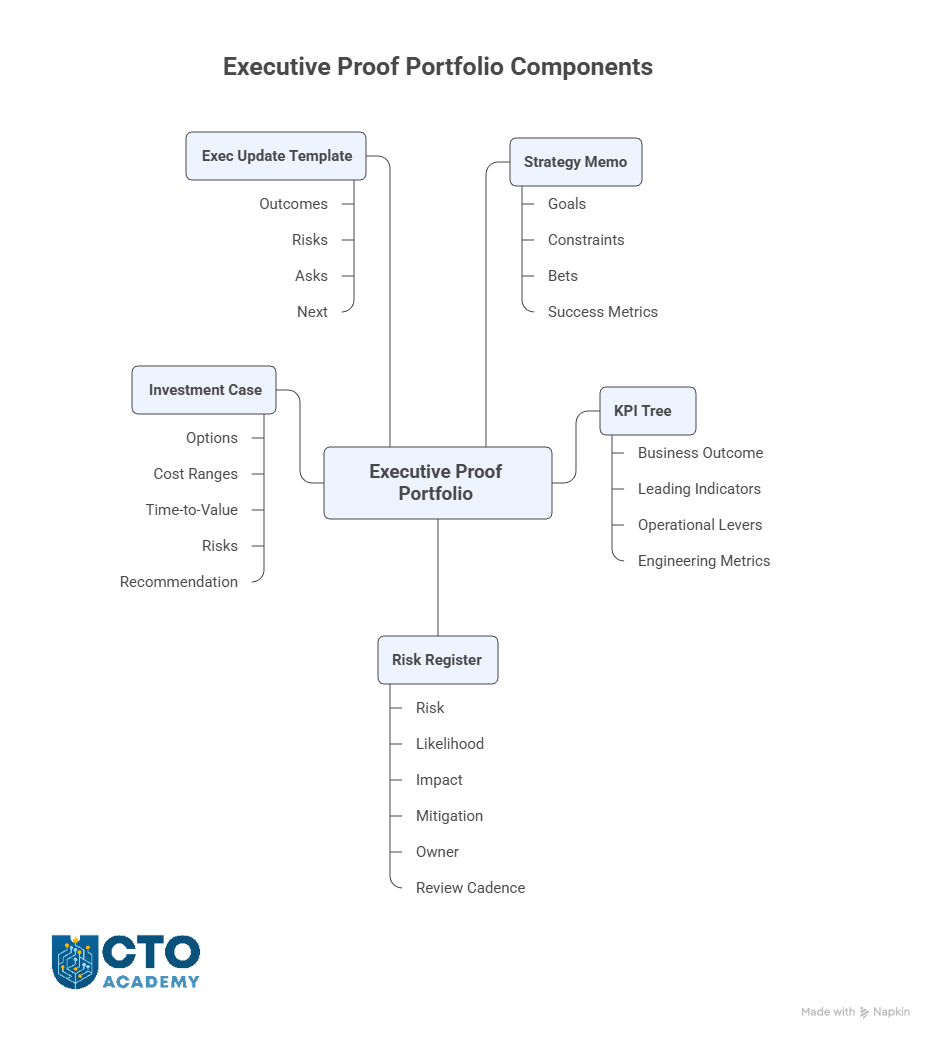
1) The strategy memo (1–2 pages)
What does it do? It proves you can set direction and align stakeholders.
Include:
- Goals (business outcomes, not internal initiatives)
- Current constraints (what’s true right now)
- 3 bets (and what you’re not doing)
- Success metrics (what changes if you’re right)
2) The KPI tree (one page)
What does it do? It proves you can translate engineering into business outcomes.
Start with the business outcome, then break it down:
- Business Outcome → Leading Indicators → Operational levers → Engineering Metrics
When you’re choosing delivery signals, anchor your dashboard in evidence-based measures like DORA’s four key metrics—a simple way to balance speed and stability without falling into vanity metrics.
3) The risk register (top 5)
What does it do? It proves executive-level ownership.
Make it boring and consistent:
- Risk, likelihood, impact, mitigation, owner, review cadence
4) The investment case (one page)
What does it do? It proves financial framing and decision quality.
Include:
- Options (A/B/C), cost ranges, time-to-value, risks, recommendation
5) The exec update template (weekly)
What does it do? It builds visibility without self-promotion.
Format:
- Outcomes (what changed)
- Risks (what could break)
- Asks (decisions or support needed)
- Next (what happens next week)
This portfolio is what turns “great engineering manager” into “obvious next-level leader.”
How to Think About Your Broader Engineering Manager Career (so you don’t optimize the wrong thing)
A promotion scorecard works best when it fits inside an actual career map. Otherwise, you end up maxing out one role and missing the bigger trajectory. In other words, you might unwittingly optimize the wrong thing.
If you want a bigger-picture framework…
If you want a bigger-picture framework for your engineering manager career, you can use CTO Academy’s Tech Career Master Guide to map milestones and stay resilient—especially in an AI-shaped market.
Use it like this:
- The career guide helps you choose where you’re going
- This scorecard helps you decide what to build next
- Your proof portfolio makes the change visible to the people who decide promotions
A Structured Path to Close Your Gaps (without pausing your job)
If your scorecard reveals predictable gaps—strategy, finance, influence, risk—here’s the honest question:
Do you want to patch those gaps by collecting random content, or do you want a structured, practitioner-led path that’s designed for technology leaders?
CTO Academy’s Digital MBA for Technology Leaders is explicitly positioned around the shift you’re trying to make: commercial fluency, strategic vision, and executive readiness—without stepping away from work.
What makes it fit an engineering manager promotion timeline
- 9 executive-level modules mapped to the exact competencies above
- 200+ practitioner-led micro-lectures with supporting resources, tests, and flashcards
- Weekly Q&A sessions and peer learning (so you’re not learning in isolation)
- A delivery model built for busy schedules (released in modules, with a consistent structure)
- Lifetime access and up to 12 months to complete
- No capstone project (designed to integrate with working life)
- A CPD-certified completion certificate
Your Next Step
If you’re ready to close your gaps with a structured path, explore the Digital MBA for Technology Leaders and join the next cohort (date shown on the program page).
Frequently Asked Questions (FAQ)
What is an engineering manager promotion readiness checklist
An engineering manager promotion readiness checklist is a structured way to assess whether you’re demonstrating the competencies senior leaders associate with higher scope. These are: strategy, business alignment, risk ownership, financial framing, and the ability to scale outcomes through teams.
The goal isn’t to “score high.” It is to identify gaps and produce visible proof points that de-risk your promotion.
How do I know if I’m ready for an engineering manager promotion?
You’re likely ready when you can show repeatable evidence in at least a few of these areas:
– You set direction (not just deliver)
– You translate engineering into business outcomes
– You make and defend trade-offs
– You manage risk proactively
– You scale outcomes through people and systems
If those show up consistently—and stakeholders beyond engineering can see them—you’re closer than you think.
What proof points matter most for senior engineering manager promotion decisions?
The most persuasive proof points are forwardable artifacts plus measurable outcomes. Examples:
– A strategy memo that aligns stakeholders
– KPI tree tied to business outcomes
– Risk register that drives mitigations
– Investment case that speeds decisions
– Weekly exec updates that show judgment and clarity
In promotion conversations, these artifacts help others tell your story for you.
How long does it take to become promotion-ready?
If you’re already operating as a strong engineering manager, targeted gap-closing often takes 30–60 days to produce meaningful proof points, assuming, of course, you pick the right gaps and create visible artifacts. Longer-term readiness (especially for Director scope) comes from repeating those behaviors until they’re consistent and trusted.
Key Takeaway
You don’t get promoted because you want it. You get promoted when leadership can confidently say: “They’ve already been doing the job—at a higher scope—and the business is safer with them owning it.” Hence, the keywords of the modern tech leadership career: owning it.
Use the scorecard. Build the proof portfolio. And if you want a structured path that maps to the same executive competencies—strategy, finance, influence, risk, and leadership systems—the Digital MBA for Technology Leaders is built for exactly that transition.