In this post, Jason Noble, Academy’s Chief Technology Officer, explains the design of highly relevant CTO KPIs and shows you how to a) track them and, more importantly, b) use them to improve performance.
Now, the odds are that you’re either a CTO in a start-up or fast-growing company or soon to become one. That implies a more hands-on approach. So the key performance metrics such as CSAT, Churn rate, CLTV, and similar are, perhaps, not exactly your primary interest. We will, however, briefly explain some of those also.
But first, let’s focus on your primary issue at this point and that is getting those KPIs that are most relevant to your organisation at its current stage of development.
Key CTO KPIs in Start-Ups and Fast-Growth Companies
Productivity is best measured if we frame the metrics inside the Cost-Quality-Time Triangle. Any change in the development process will have an impact on one of these factors.
But first, word of caution. If you apply KPIs to the technology team’s output, you must understand their potential impact. You can easily affect morale and, consequently, decrease productivity.
That said, you should use these metrics as tools for growth and learning only. They are not meant to serve any kind of repressive purpose (eg, trying to get more done with fewer people).
As a rule of thumb, KPIs for technology teams will revolve around one of the three corners of the triangle. Hence, by focusing on one segment, you use the metric to focus on and improve that specific area. As a result, you are not overstressing remaining factors while allowing the team to improve rather than destabilise outputs.
1. TIME
1.1 Story issues/questions reduction
What you, ultimately, want to see is a decreasing number of issues and/or questions during the sprint. Raised issues affect the speed and might indicate that you need to redefine the story.
1.2 Bug-fixing/development time ratio
FORMULA: The percentage of time spent on bug fixing versus development time.
This KPI allows the CTO to monitor the ratio and prevent a negative impact on output. For instance, when engineers are too focused on the output speed, they might neglect basic principles and rush the code test, falsely believing that it helps ship the code much faster.
1.3 Story cycle time
It is, basically, the time it takes to close a story once you open it.
If you find this metric rising, it could be either due to blockers that arise during the sprint or because there are too many open stories. The simplest fix is to apply the work-in-progress limit. This speeds up the cycle time of individual stories and, therefore, improves the overall workflow.
1.4 The average time of the story’s blocked status
If you suspect this to be longer than optimal, check for possible communication breakdown and/or improve the story.
Development teams will not worry about the time taken to build or deploy code as this happens automatically. This is true but as a leader, you need to consider if your engineers idle for too long due to over-complicated deployments into an environment.
So do try to assess how much of their productive day is being lost or wasted whilst waiting. If you find such fluctuations, look at the reasons for the slowdowns and see how they can be improved.
2. COST
2.1 Cost per story point per week
FORMULA: Developer cost divided by the story points.
Often, the easiest way to increase the team’s velocity will be to increase the number of resources in the team developers, testers, devops etc. This will allow more work to flow, but it will inevitably incur additional costs.
As a technical leader, it is your job to balance the team output versus the cost and this KPI will give you a benchmark so you can recognise the tipping point.
2.2 The percentage of non-used features
FORMULA: Percentage of features used in production x Number of days after release.
By tracking this metric, you will learn how to improve your prioritisation process.
The logic behind it is simple: the fewer deployed but not used features mean that the overall cost of product development goes down.
2.3 Throughput per sprint
In other words, how much work is actually being done? Naturally, you want to monitor this specific metric over time.
2.4 Average compile time
Time spent on compiling is, essentially, a wasted engineering time. Therefore, see how you can improve the build process either by having optimal resources or special tools. Also, ensure that you maintain a lean compile and deployment cycle.
3. QUALITY
In other words, quality engineering metrics.
3.1 Bug fixes per sprint
FORMULA: Average number of bug fixes per sprint.
To build up your quality more efficiently, you should address any code that undergoes multiple testing and bug-fixing cycles. This will not only affect your delivery speed but also the overall quality of your team’s work.
3.2 Incidents per deployment period
FORMULA: The number of incidents in live per deployment time period.
Tracking incidents, especially P1s and P2s, and being able to track them back to the deployment is a key way of creating good quality feedback loops.
3.3 Codebase coverage
If you measure the code executed via automation tests and get 100%, it may give you a false sense of confidence that your code is completely tested. There is a high probability that too much effort has been put into the testing automation for the return on investment.
You must, therefore, find the correct success measure for your business considering its current state of growth.
HINT: over 90% is generally considered as good.
Backlog Monitoring
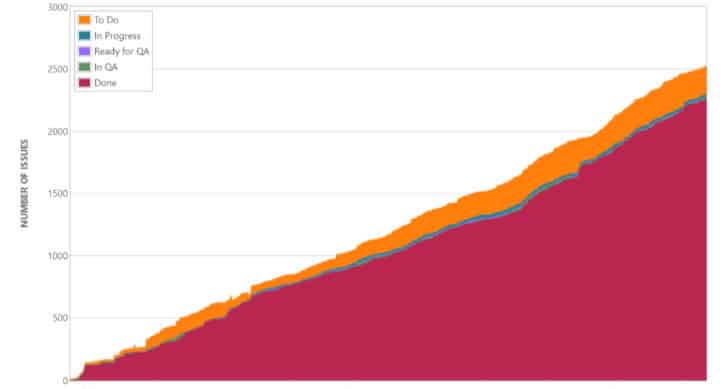
If you see your backlog growing, you either need to hire more developers or improve the efficiency of your team. That, of course, assumes that the backlog is free of trash.
Use your CTO dashboard to visualise the backlog like in this example:
Additional CTO KPIs and Metrics
1. Customer Satisfaction (CSAT) – Measures customer satisfaction with technology products/services. This KPI is more used by enterprise or Group CTOs.
2. Churn Rate – Measures customer attrition rate over a specific period. It is commonly used in conjunction with a Net Promoter Score that measures customers’ loyalty to the company. For tech-oriented companies, these scores can indirectly show how well the market adopts the technology. Low scores, therefore, may indicate the need for change.
3. System Uptime, Load Time and Reliability – Measures the operational efficiency which is fundamental for user trust.
4. Time-to-Market – Measures the speed at which new technology products or updates are brought to market, which is critical for competitiveness and responsiveness to market demands.
5. Technical Debt – Managing technical debt is essential for long-term sustainability and maintaining development agility.
6. Scalability – Assessing the ability to handle increased load or demand is crucial for accommodating business growth and maintaining performance.
7. Release Frequency and Lead Time – Measures development and deployment efficiency, allowing for quicker responses to market needs.
8. Technology ROI (Return on Investment) – Measures the financial impact of technology investments, providing insights into cost-effectiveness.
When used correctly, all these KPIs guide strategic decisions, inform improvements and ensure that technology initiatives align with organisational goals. So be careful with any rollout to avoid affecting team morale. Instead, use metrics to help your developers improve their skills.
Since the Remote CTO works from a different location than the company’s headquarters, a set of challenges arises for the Chief Technology Officer and the employer. In this article, we are: a) examining the most critical challenges and, more importantly, b) providing practical solutions.
So if you are new to the role and still struggling to facilitate seamless relationships, processes and operations, this is the guide for you.
Problems That Stem From Differences Between a Remote CTO and an In-House Position
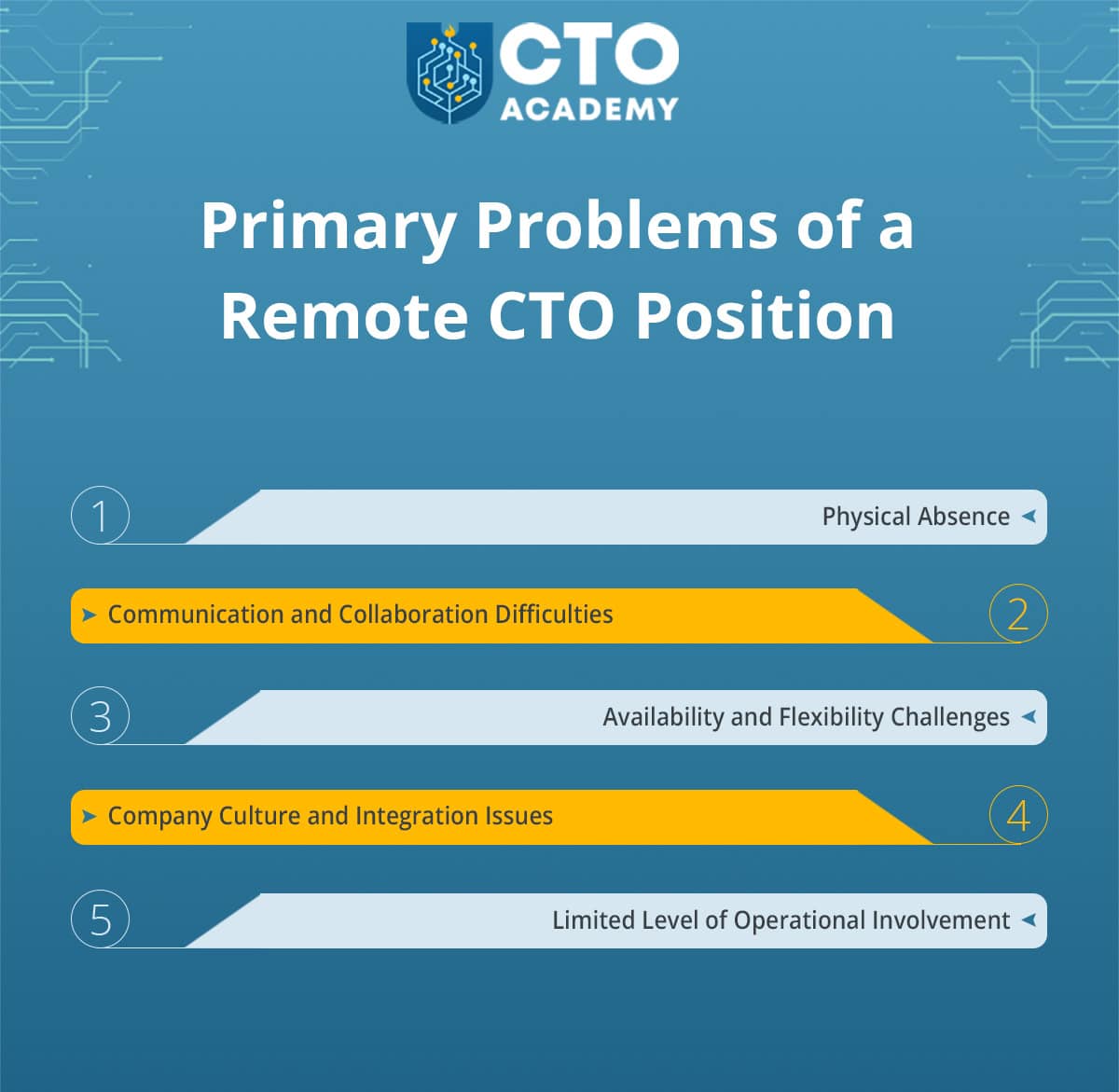
(click to enlarge/download)
The differences between the two arise from the:
Physical presence
Communication methods
Availability
Depth of involvement in day-to-day operations
Company culture
#1 – Physical Presence
As remote CTOs operate outside the company’s physical location, they are at a disadvantage compared to the in-house tech leader. Physical absence can allow problems to escalate as they may not be picked up quickly.
#2 – Communication and Collaboration
In contrast to a traditional form of employment, remote work relies exclusively on digital communication tools. As we all know, they can cause frequent issues as a major part of communication is body language which we pick up subconsciously.
The problem is that when you are not able to see the whole body and general attitude around the office, you can miss clues that something is not right.
#3 – Availability and Flexibility
An in-house chief technology officer is immediately accessible for urgent matters, team meetings or on-site support. Remote CTOs, on the other hand, may have limited availability for synchronous collaboration.
#4 – Company Culture and Integration
An in-house chief technical officer can immerse more effectively in the company culture, build relationships with employees and gain a deeper understanding of the dynamics.
Since the remote CTO doesn’t have such a good overview of the work environment, internal processes and team interactions, it is harder for them to understand and integrate into the company culture.
On the bright side, many companies have moved to a hybrid culture, so there is now more acceptance that culture and integration can take longer than previously.
Due to their physical absence, a remote chief technology officer commonly has a more strategic focus. They provide guidance, advise on technology decisions and oversee projects. But to do any of that, they must rely on the internal team or external partners for operational execution.
Top Challenges for a Remote CTO (and Their Respective Solutions)
Integration into Company Processes
Whether you are a software engineer, technical project manager, engineering manager or product manager, there is a good chance that you’ll face some universal challenges. And these challenges can seriously undermine the integration process.
For instance…
Social Overload
Are you feeling overwhelmed by constant social interaction and engagement? Is this sensation emphasised in a remote setting?
What can you do to prevent the overload?
Set boundaries – set clear boundaries around social interactions and allocate specific time slots for social engagement. Make sure that a) everyone’s aware of them, and b) respects them.
Schedule breaks – use them for quiet, solitary activities that help you relax and regain energy.
Plan social interactions – schedule specific times for meetings, team discussions or informal chats, instead of being constantly available.
Limit the pressure of immediate interaction – leverage communication tools to strike a balance between engagement and solitude.
Remote Relationship Building
Are you experiencing difficulties initiating conversations or forming connections? Does a remote environment heighten this problem?
Here are a few tips to meet this challenge:
Initiate and prioritise one-on-one conversations with team members and key stakeholders.
Practise active listening during virtual meetings and conversations:
a) Give your full attention to the speaker.
b) Ask thoughtful questions.
c) Show genuine interest in ideas and experiences.
Open up and share personal insights or experiences with your colleagues when appropriate.
Participate in team-building activities.
Use non-work communication channels to connect with colleagues on a more personal level.
To reduce the anxiety and become more self-confident, try these methods:
Prepare in advance (ie., review the agenda, gather your thoughts and consider/anticipate potential discussion points).
Share thoughts in writing (to articulate your points more effectively).
Practise active listening (focus on understanding others’ perspectives and ideas, and ask clarifying questions).
Use messaging features (share your input or questions through the chat function).
Do follow-ups (if you find it challenging to express your thoughts during a meeting).
Practise pacing and timing (ie, observe the flow of conversations and find opportunities to time and pace your contributions effectively instead of speaking up immediately in every meeting).
Request agenda items in advance.
Gradually increase participation.
Make sure outcome actions are clearly stated at the end of the meeting.
Being Overlooked or Undervalued
This fear can stem from concerns about not having the same level of visibility and opportunities for recognition in a remote setting where physical presence is reduced.
Here are some actions that help:
Proactively share accomplishments (ie, highlight the impact of your work and the value you bring to the organisation through regular updates).
Seek feedback from time to time (from colleagues, superiors and team members).
Cultivate relationships with key decision-makers.
Don’t shy away from advocating for yourself and your ideas.
Look for opportunities to position yourself as a thought leader in your field.
Build strong relationships with colleagues and team members through collaboration and support (to create a network of allies).
Share your insights, expertise and knowledge with the broader team and organisation.
Communication and Collaboration Challenges
Challenges:
Must rely on digital tools.
Different time zones.
Language barriers.
Technical issues with communication platforms.
How Do Remote CTOs Address These Challenges?
#1 – Digital tools (communication)
Identification and implementation of reliable communication and collaboration tools (requires experience and deep knowledge of appropriate SaaS).
Having clear guidelines and instructions on using these tools (check to see if everyone is comfortable and proficient in their usage).
Creating and nurturing a culture of open and transparent communication (ie, encouraging team members to actively participate and share their thoughts).
Maintaining regular (virtual) team meetings.
Encouraging asynchronous communication (eg, project management tools, shared document repositories, task-tracking systems etc).
#2 – Different time zones (distributed team collaboration)
Establishing shared working hours and/or overlap periods.
Communicating availability and response times to team members.
Leveraging time zone conversion tools and scheduling applications to streamline meeting coordination.
Documenting important discussions and decisions for team members who may not be available during synchronous communication.
#3 – Language barriers
Encouraging open and inclusive communication.
Recognising (and respecting) language differences.
Active listening and asking for clarification (if any language-related misunderstandings arise).
#4 – Technical issues with communication platforms
Troubleshooting and addressing technical issues.
Establishing alternative communication channels and backup tools (in case of platform failures).
Maintaining a list of technical support contacts or resources (for quick access and response).
Conducting periodic tests and rehearsals.
Building Relationships and Company Culture
Challenges:
Limited face-to-face interaction.
Building trust and rapport.
Maintaining a cohesive company culture.
Communication and collaboration barriers.
Fostering employee engagement and motivation.
Address These Challenges with These Measures/Actions
#1 – Limited face-to-face interaction
Schedule regular team catch-ups and one-on-one video calls to simulate face-to-face interaction and build personal connections.
Foster virtual socialisation for team members to socialise and get to know each other on a personal level (eg, virtual coffee breaks, team-building activities etc).
Plan occasional in-person meet-ups when feasible and safe.
Encourage open communication channels for team members to freely engage in informal conversations.
#2 – Building trust and rapport
Set clear expectations to ensure that everyone’s on the same page (ie, clearly communicate expectations, goals and responsibilities).
Attentively engage with team members to understand their concerns and provide useful and thoughtful responses.
Be reliable and responsive (ie, consistently follow through on commitments, respond promptly to inquiries and requests and demonstrate reliability).
Encourage transparency.
Recognise and appreciate contributions.
#3 – Maintaining a cohesive company culture
Clearly articulate the company’s core values and ensure they are communicated regularly to remote team members (to establish a shared company culture).
Encourage virtual team-building activities such as virtual exercises, games or challenges (to promote collaboration, foster a sense of belonging and reinforce the company culture).
Share success stories (to strengthen the sense of unified company culture).
Establish virtual rituals such as virtual team lunches or monthly all-hands meetings (to bring the team together and reinforce the company culture).
Provide opportunities for cross-team collaboration (to facilitate cross-pollination of ideas and strengthen connections across the organisation).
# 4 – Communication and collaboration barriers
Establish clear communication guidelines (ie, define communication norms, preferred channels and response expectations).
Foster an inclusive environment (ie, ensure everyone has an equal opportunity to contribute).
Leverage collaborative tools.
Promote asynchronous communication (accommodate different time zones to enable effective collaboration across distributed teams).
Provide training and resources.
# 5 – Fostering employee engagement and motivation
Regular check-ins and feedback.
Recognise and celebrate individual and team achievements.
Encourage autonomy and ownership of their work.
Provide professional development opportunities (eg, skill development, training and career growth).
Foster a positive and supportive virtual work environment (eg, encourage positivity, celebrate diversity, maintain regular communication etc).
Employ performance-tracking tools (for both individual and team performance monitoring). This needs to be done very carefully to prevent disquiet over too much oversight.
Encourage a culture of continuous feedback.
Create a supportive environment for growth and improvement.
Publicly acknowledge and reward individual and team achievements.
#4 – Managing work-life balance
Promote the establishment of clear boundaries between work and personal life for all remote team members.
Provide guidance on remote work best practices.
Set realistic expectations, respect boundaries and encourage team members to prioritise self-care and personal time.
Allow flexible work schedules (when feasible).
Support employee well-being initiatives (ie, provide access to resources, mental health support if necessary and virtual wellness activities).
Lead by example.
Managing Time Zones and Availability
Challenges:
Scheduling and coordination.
Communication gaps.
Reduced overlap for collaboration.
Availability for emergencies.
Solutions
#1- Scheduling and coordination
Allow individual calendars to be viewable so that availability is public.
Use scheduling tools that automatically convert meeting times to local time zones.
Establish designated meeting times that overlap as much as possible.
Encourage proactive communication and provide advance notice of meetings and events.
Consider rotating meeting times periodically to spread the inconvenience of early or late meetings.
#2 – Communication gaps
Foster a culture of clear and concise communication (ie, emphasise the importance of providing context and proactive information sharing).
Leverage asynchronous communication tools.
Document important discussions, decisions and action items (to ensure seamless access at a later time).
Encourage team members to:
a) Set clear expectations regarding response times.
b) Clearly communicate their availability.
Create a central platform for sharing updates and progress.
#3 – Reduced overlap for collaboration
Identify and prioritise key collaborative activities that require real-time participation
Schedule these activities during overlapping hours whenever possible.
Leverage project management tools and shared workspaces (to enable team members to contribute and access project information asynchronously).
Implement effective task management systems and clearly define:
a) Responsibilities
b) Deadlines
c) Dependencies
Use video conferencing and screen-sharing tools for important discussions or collaborative sessions (even if they occur during non-standard working hours for some team members!).
Encourage regular and proactive communication within the team (to ensure that everyone stays aligned, even if direct collaboration is limited).
#4 – Availability for emergencies
Establish a clear protocol or escalation process for emergencies.
Ensure that at least one team member is available to address urgent matters.
Implement a shared on-call or rotating availability schedule (to spread the responsibility among team members).
Ensure that critical documentation, contact information and access credentials are readily available and accessible to authorised team members at all times.
Use emergency communication channels to quickly alert and gather team members when necessary.
Conduct periodic reviews and updates of emergency response procedures to ensure their effectiveness and relevance.
Conclusion
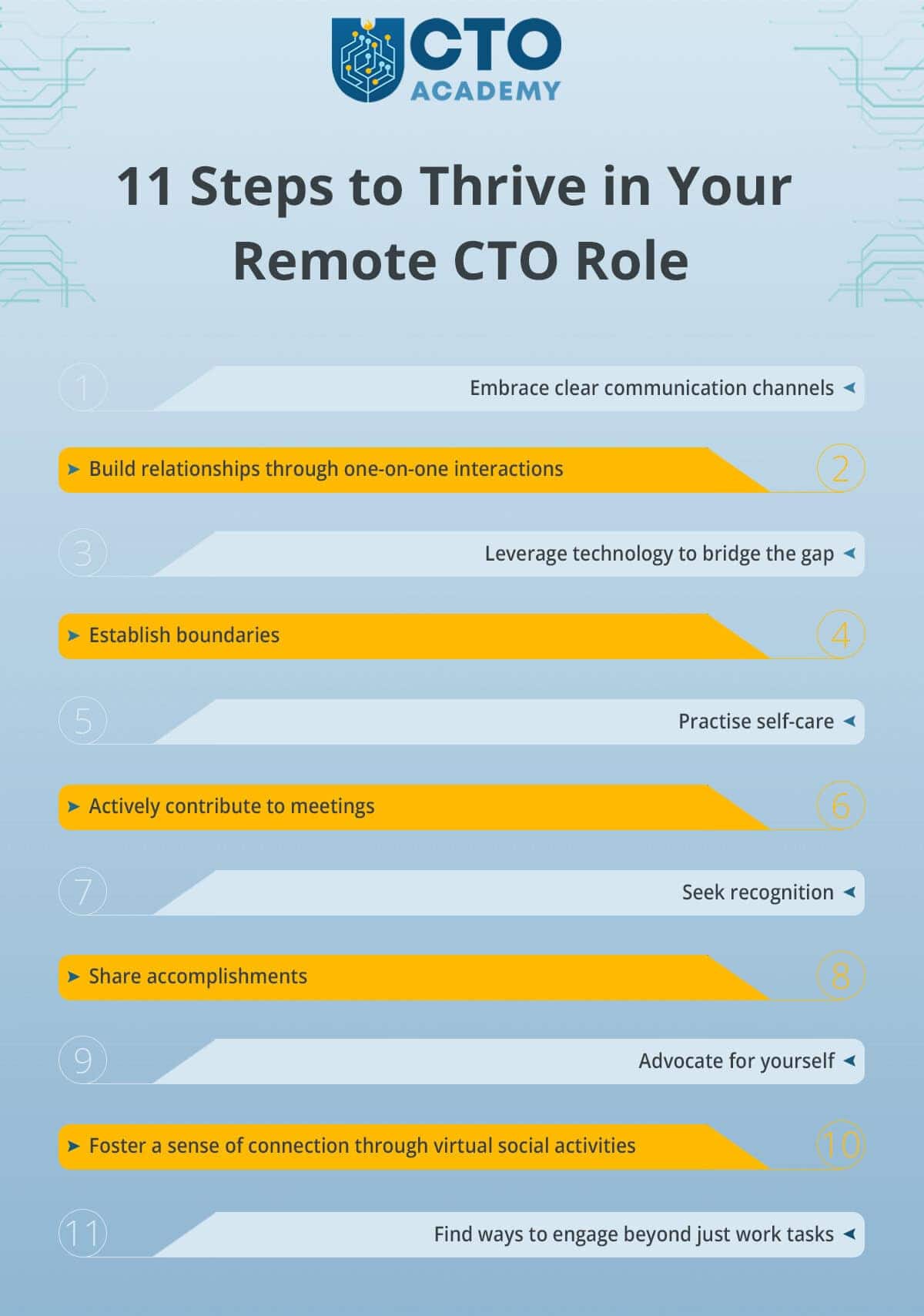
To thrive in your Remote CTO role:
Embrace clear communication channels.
Build relationships through one-on-one interactions.
Leverage technology to bridge the gap.
Establish boundaries.
Practise self-care.
Actively contribute to meetings.
Seek recognition.
Share accomplishments.
Advocate for yourself.
Foster a sense of connection through virtual social activities.
Built on experience, it is packed with valuable insights about the CTO role. A good part of it details the integration process into a new organisation for technology leaders. Enjoy!
An IT director is a senior-level executive overseeing the technology infrastructure, systems and operations. Sometimes called a director of technology, this type of tech leader plays a crucial role in ensuring that the organisation’s technology supports its strategic objectives and provides efficient solutions for the business.
Generally speaking, the job requires a balance between strategic thinking, technical expertise, leadership and effective communication. All of this is necessary to drive technology initiatives and support the organisation’s success.
This guide, therefore, provides aspiring technology leaders, such as software engineers, with valuable insights into the responsibilities, skills, experience and knowledge necessary to embark on a successful journey towards this influential role.
Make no mistake; you will need this cheat sheet because as a director of information systems, you not only oversee the strategic direction and management of technology, but you also play a pivotal role in driving innovation, ensuring operational efficiency and aligning technology with business goals.
So first, let’s explain the most common misconception.
Is the IT Director the same as the Head of IT Department?
Most commonly, no. The head of the IT dept typically refers to the individual who is specifically responsible for managing and leading the IT department. Their focus is primarily on the operational aspects of the department, such as infrastructure management, systems administration, software development and user support. They work under the guidance of the IT director and are responsible for executing the IT strategy and ensuring the smooth operation of IT services.
The IT director, on the other hand, is a leadership position that encompasses broader responsibilities beyond just managing the IT department. This role typically involves overseeing the strategic planning, technology vision and overall management of technology within the organisation — including the IT department.
Understanding the Significance of the IT Director Role
As stated earlier, you hold a pivotal position at the intersection of technology and business strategy. Your job description involves shaping the organisation’s technology vision, driving innovation and ensuring that technology initiatives align with business goals. By overseeing the management of IT infrastructure, projects and teams, you have the power to optimise operations, enhance cybersecurity and enable digital transformation.
What’s perhaps even more important to understand is that the role is not just about technical expertise; it’s about being a strategic leader who can harness the power of technology to drive organisational success.
1. The Role of an IT Director
From strategic planning to team management, budgeting to project oversight, an IT director plays a pivotal role in shaping the organisation’s technology vision and ensuring the alignment of technology initiatives with business objectives. So in this section, we will delve into the diverse responsibilities that define the role of an IT director, providing valuable insights for aspiring leaders seeking to make a significant impact within the technology landscape.
1.1. Defining the Responsibilities of an IT Director Role
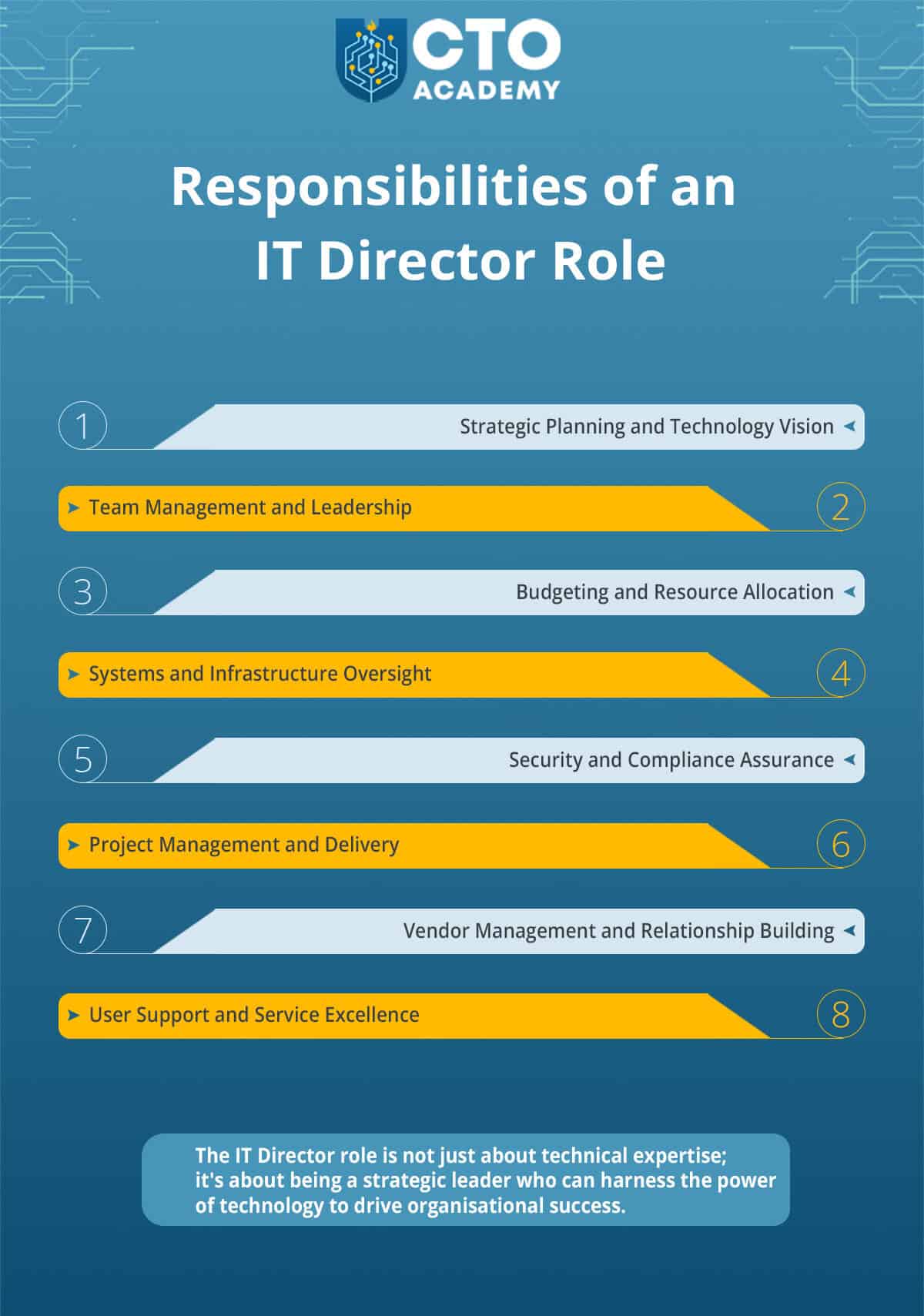
(click to enlarge/download)
Strategic Planning and Technology Vision
Developing a long-term roadmap for technology initiatives that align with the organisation’s overall business strategy.
Identifying emerging technologies, assessing their potential impact and formulating strategies to leverage them effectively.
Understanding of the organisation’s goals and objectives to define a clear vision for technology implementation, innovation and digital transformation. This drives growth, enhances operational efficiency and helps maintain a competitive edge.
Team Management and Leadership
Overseeing and guiding the IT department’s personnel; ie, fostering a collaborative and productive work environment.
Providing direction, setting performance goals and empowering team members to achieve their full potential.
Effective communication, mentorship and resource allocation.
Ensuring the availability of skilled professionals, promoting teamwork and maximising productivity to deliver successful technology outcomes.
Budgeting and Resource Allocation
Managing the financial aspects of the IT department, including creating and overseeing the IT budget, ensuring cost-effectiveness and allocating resources efficiently.
Prioritising investments, evaluating vendor contracts and optimising IT spending while considering the organisation’s strategic objectives.
Ensuring that technology initiatives are adequately funded, aligned with business needs and that they deliver value to the organisation — all while maintaining financial stability.
Systems and Infrastructure Oversight
Ensuring the smooth operation and reliability of the organisation’s technology infrastructure.
Overseeing the design, implementation and maintenance of systems, networks, servers and software.
Ensuring optimal performance, scalability and security of the infrastructure (while staying updated with technological advancements).
Identifying areas for improvement.
Implementing strategies to enhance the organisation’s overall technological capabilities.
Security and Compliance Assurance
Implementing and maintaining robust security measures to protect the organisation’s information assets from cyber threats.
Ensuring compliance with relevant regulations and industry standards.
Developing security policies and procedures.
Conducting risk assessments, and establishing incident response plans.
Overseeing security awareness training and staying updated on the latest security trends to proactively address potential vulnerabilities and mitigate risks to the organisation’s data and systems.
Project Management and Delivery
Overseeing the planning, execution and successful completion of technology projects.
Defining project objectives, creating project plans, assigning tasks and monitoring progress to ensure projects are delivered on time and within budget.
Coordinating with stakeholders, managing resources, and mitigating risks to achieve project goals.
Employing effective project management methodologies to ensure the smooth implementation of technology initiatives, innovation and organisational growth.
Vendor Management and Relationship Building
Selecting and managing technology vendors, negotiating contracts and maintaining strong relationships with them.
Ensuring that vendor solutions align with the organisation’s needs, budget and quality standards.
Overseeing vendor performance, resolving issues and facilitating effective communication.
Fostering collaborative relationships with vendors to:
a) Maximise the value derived from vendor partnerships
b) Promote innovation
c) Ensure the delivery of high-quality technology solutions to support organisational objectives.
User Support and Service Excellence
Ensuring end-users receive prompt and effective technical assistance, troubleshooting and problem resolution.
Establishing and maintaining user support processes, overseeing the help desk function, and monitoring customer satisfaction.
Provide exceptional service, improving user experience and continuously enhancing support procedures.
Prioritising user needs and delivering high-quality support to:
a) Foster a positive technology environment
b) Increase productivity
c) Strengthen the organisation’s overall technological capabilities.
1.2. How to Obtain the Necessary Knowledge and Experience to Fulfil These Responsibilities
We recommend adopting a holistic approach. It involves a combination of formal education (ie, a relevant degree in technology, computer science, information systems or business administration), professional certifications (eg., ITIL, PMP, CISSP, CISM or technology leadership courses), hands-on experience, continuous learning and mentorship opportunities.
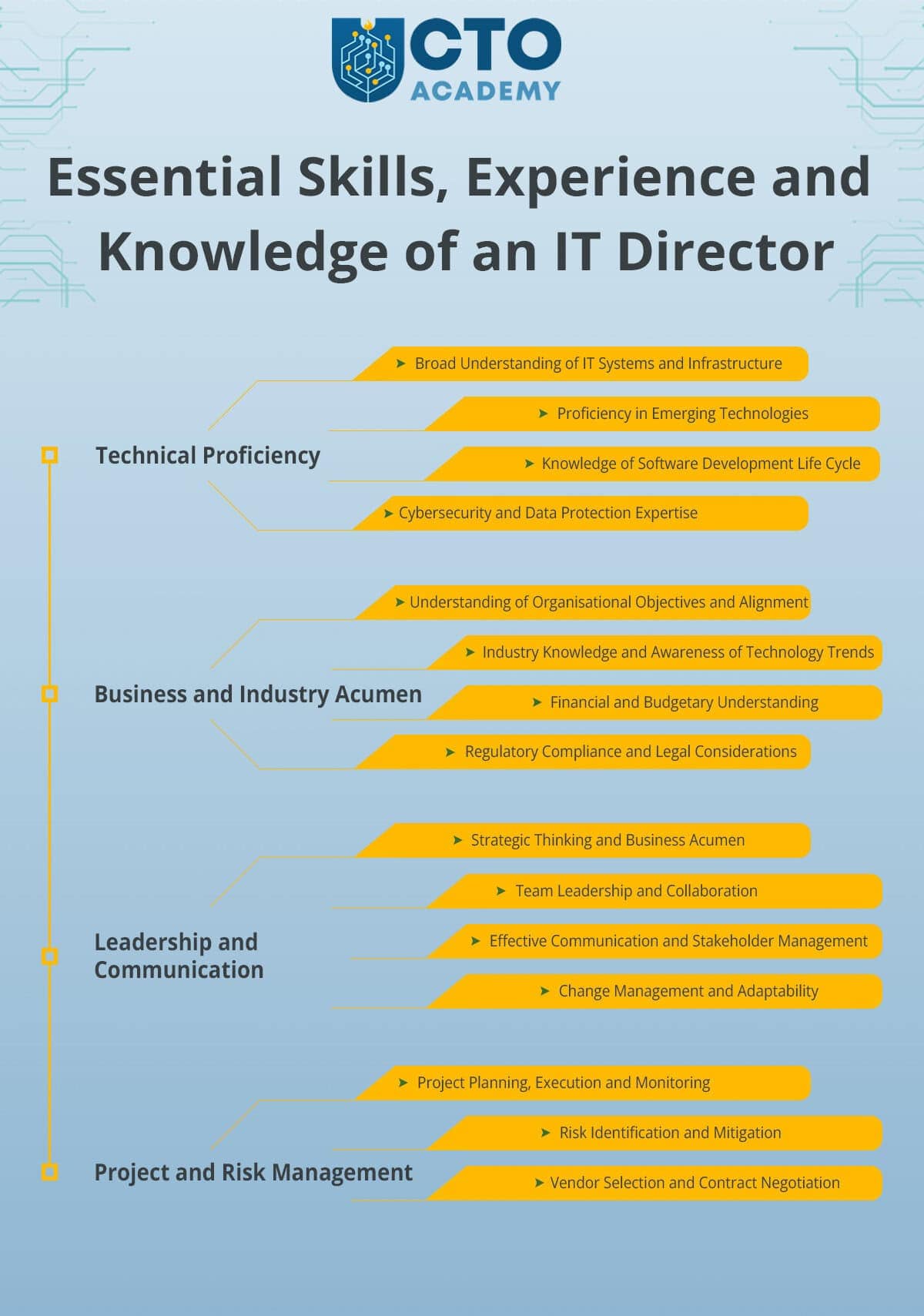
Beyond technical expertise, this role demands a blend of leadership, communication and strategic thinking abilities. This section, therefore, focuses on the key competencies that enable IT directors to effectively navigate the complex landscape of technology leadership. From technical proficiency and business acumen to project and risk management skills, we will explore the essential qualities that aspiring IT Directors should cultivate.
2.1. Technical Proficiency
Broad Understanding of IT Systems and Infrastructure
You must possess comprehensive knowledge of networks, hardware, software, databases and cloud computing. This will allow you to:
Make informed decisions.
Oversee system performance.
Identify improvement opportunities.
Ensure effective integration and compatibility among different technology components.
Only then you can effectively lead and guide technology initiatives, ensuring their alignment with the organisation’s goals and objectives.
Proficiency in Emerging Technologies
This includes artificial intelligence, machine learning, blockchain, cybersecurity, cloud computing and data analytics.
TIP: Some of the good sources of up-to-date information on emerging tech are definitely TechRadar, Gartner and Tech Brew.
By being well-versed in emerging technologies, you can:
Identify opportunities to leverage these innovations for strategic advantage.
Drive digital transformation initiatives.
Ensure the organisation remains competitive in an evolving technological landscape.
Make informed decisions regarding the adoption and implementation of cutting-edge technologies that align with business goals.
Knowledge of Software Development Life Cycle (SDLC)
In other words, understanding the structured process of developing software applications. This encompasses familiarity with various stages of the SDLC, including requirements gathering, design, development, testing, deployment and maintenance.
It allows you to:
Effectively oversee software development projects.
Collaborate with development teams.
Manage project timelines.
Ensure the delivery of high-quality software solutions.
Identify potential risks.
Optimise development processes.
Align software development efforts with organisational objectives.
Cybersecurity and Data Protection Expertise
This refers to possessing in-depth knowledge and skills related to safeguarding digital assets from threats and ensuring data confidentiality, integrity and availability.
More specifically, it entails:
Understanding security frameworks.
Conducting risk assessments.
Implementing security measures.
Staying updated on emerging threats and industry best practices.
This, in turn, will allow you to effectively mitigate risks, proactively address security vulnerabilities and maintain a secure technology environment that safeguards sensitive information from unauthorised access, breaches and data loss.
2.2. Business and Industry Acumen
Understanding of Organisational Objectives and Alignment
Comprehending the goals, values, and strategic direction of the organisation.
Aligning technology initiatives with objectives to drive business success.
Understanding the industry, market trends and competitive landscape to make informed decisions about technology investments; hence, to better prioritise projects that deliver value and support the organisation’s overall strategic objectives.
Industry Knowledge and Awareness of Technology Trends
Staying informed about the latest advancements and trends within the industry and how they impact technology landscapes.
Understanding industry-specific challenges, emerging technologies and market dynamics.
Anticipating industry shifts.
Identifying opportunities for innovation.
Strategically aligning technology initiatives with industry trends (to gain a competitive edge and drive organisational success).
Financial and Budgetary Understanding
In other words, comprehending financial principles and budgetary processes relevant to technology initiatives. This is important because you want to ensure that technology initiatives contribute to the organisation’s profitability and long-term financial sustainability and not become a heavy overload that can sink the ship.
This predominantly includes the following:
Managing budgets, tracking expenses and making informed decisions regarding resource allocation and cost optimisation.
Understanding financial statements, financial forecasting and return on investment (ROI) analysis to effectively align technology investments with financial goals.
Regulatory Compliance and Legal Considerations
Technology operations are governed by relevant laws, regulations and industry standards. So one of the responsibilities is to mitigate potential legal and reputational risks.
The IT director must:
Ensure data privacy, protection and ethical use of technology.
Manage risks associated with legal and compliance requirements.
Stay updated on changing regulations, assess their impact on technology initiatives and implement measures to ensure compliance.
2.3. Leadership and Communication
Strategic Thinking and Business Acumen
It comes down to the ability to analyse the broader business landscape, identify opportunities and align technology initiatives with organisational goals.
Requirements:
Understanding the organisation’s strategic objectives.
Making informed decisions.
Effectively communicating the value of technology solutions to stakeholders.
Gains:
Drive innovation.
Foster collaboration between technical and business teams.
Ensure that technology initiatives contribute to the overall success and growth of the organisation.
Team Leadership and Collaboration
This involves effectively leading and managing teams, fostering a collaborative work environment and empowering team members to achieve their full potential.
You do all of that by:
Setting clear goals.
Providing guidance and support.
Promoting open communication.
Fostering a culture of trust and teamwork.
Keep in mind that one of your primary responsibilities as an IT director is to create a system that drives innovation, enhances productivity and creates a cohesive and high-performing team that delivers successful technology outcomes. That’s the backbone of everything.
Translated, it means that your #1 focus is on the team because, without a well-performing cohesive team, you can forget about success.
Effective Communication and Stakeholder Management
Effective communication and stakeholder management facilitate collaboration, build trust and ensure alignment between technology initiatives and stakeholder needs.
That said, how do you effectively advocate for technology solutions and influence decision-making to drive successful outcomes? In other words, how do you convey ideas, information and expectations clearly and concisely?
The following will help::
Active listening.
Learning how to articulate complex technical concepts to non-technical stakeholders.
Fostering strong relationships with various stakeholders.
Change Management and Adaptability
One of your jobs as IT director is to foster a culture of resilience, facilitate smooth transitions and ensure that the organisation can effectively respond to evolving technology landscapes and business needs.
You need to do the following:
Embrace a flexible mindset.
Navigate and guide teams through organisational changes.
Effectively communicate those changes.
Efficiently address resistance.
Support individuals in adapting to new technologies and processes.
2.4. Project and Risk Management
Project Planning, Execution and Monitoring
To be able to mitigate risks, address issues promptly and ensure successful project outcomes, you have to:
Effectively plan project objectives.
Allocate resources.
Create realistic timelines.
Oversee project execution.
Coordinate tasks.
Monitor progress (to ensure milestones are achieved and deliverables are met).
Risk Identification and Mitigation
By effectively managing risks, the IT director increases project success rates and safeguards the organisation’s investments in technology initiatives. This depends on the highly efficient execution of the following tasks:
Identification of potential risks that may impact project success.
Implementation of strategies to minimise the impact of the risks.
Risk assessments, potential threats analyses and continuous development of mitigation plans.
Active risks monitoring throughout the project lifecycle and taking proactive measures to address them.
Ensuring appropriate risk mitigation strategies are in place to protect project timelines, budgets and deliverables.
This is, by and large, the single most severe challenge for any IT leader. Tim Plumridge, Head of IT, breaks down risk analysis in a dedicated lecture in Module 6 – Information Management of our Digital MBA for Technology Leaders. As you can imagine, mitigating risks is at the very top of the list of duties for every IT director. So having a straightforward formula like the one Tim provides in the lecture comes in extremely handy.
Vendor Selection and Contract Negotiation
One of the responsibilities of an IT director is to maximise the value derived from vendor partnerships, minimise contractual risks and ensure successful project outcomes.
This is done through a series of steps, most notably:
Identifying and choosing the most suitable vendors for technology projects.
Negotiating contractual agreements and terms to ensure alignment with project requirements and mitigating potential risks.
Conducting vendor assessments.
Evaluating proposals (ie, considering factors such as expertise, reputation and cost.
The list is long. The responsibilities are many. In some instances, failure can result in catastrophic consequences. All of that is a compelling argument for additional professional education before applying for the position of IT director.
But what is the job outlook? What are the trends in the US and the UK?
The US Bureau of Labor Statistics reports that employment of tech leaders, including IT directors, is projected to grow by 16 per cent from 2021 to 2031. That is a significantly faster rate than the average for all occupations.
According to the World Economic Forum, 97 million new roles may emerge by 2025. These roles will be more adapted to the new division of labour between humans, machines and algorithms. Roles already growing in demand include:
Data analysts and scientists
AI and machine learning specialists
Robotics engineers
Software and application developers
Digital transformation specialists
It’s logical to assume that the emerging tech landscape will require an army of IT directors to lead these newly formed teams.
Impact of Digital Transformation
As digital technologies continue to reshape industries, many companies are pursuing large-scale change efforts to capture the benefits of these trends or simply to keep up with competitors. According to a McKinsey Global Survey on digital transformations, more than eight in 10 respondents say their organisations have undertaken such efforts in the past five years.
Some notable industry sectors that often offer significant opportunities for IT directors include:
Healthcare (currently undergoing digital transformation, focusing on electronic health records, telemedicine, healthcare analytics and cybersecurity).
Financial Services (the sector that relies heavily on technology for services such as mobile banking, digital payments, blockchain and cybersecurity).
E-commerce and Retail (the rapid growth of online shopping and the need for robust e-commerce platforms, supply chain management systems and data analytics).
Technology and Software Development
Manufacturing and Industrial Sectors (as industries embrace automation, robotics and the Internet of Things, they need qualified employees to implement and manage technology infrastructure and systems).
Government and Public Sector (require IT Directors to manage large-scale IT projects, enhance cybersecurity measures and implement digital transformation initiatives for improved citizen services).
3.2. U.K. Job Outlook
Current Demand
Tech employment in the UK reached 2,043,622 workers in 2022, which is a 1% increase over the previous year. The projected increase in 2023 is almost 1%.
A Tech Nation report claims that there’s been a huge push to encourage talent to enter the industry. There were over two million vacancies in 2021.
The demand for IT directors will only grow.
Technology Sector Growth
A press release from the Department for Digital, Culture, Media & Sport, states that the UK tech sector achieved its best year ever in 2021, with more VC investment, more unicorns, more jobs and more future corns. There has been a 50 per cent rise in overall UK tech jobs advertised in 2021 compared to 2020’s figures, with vacancies hitting 160,887 in November 2021.
Emphasis on Cybersecurity
The Cyber Security Skills in the UK Labour Market 2022 report explores the nature and extent of cyber security skills gaps (people lacking appropriate skills) and skills shortages (a lack of people available to work in cyber security job roles) in the UK. According to the findings, there is a serious issue with skill gaps in critical technology areas.
How does that impact the job outlook?
The existence of skills gaps and shortages should have a positive impact on the job outlook for IT director roles. Since companies must address these issues, there may be an increased demand for IT directors, particularly for those specialised in cybersecurity.
Influence of Brexit on Hiring Trends
The impact of Brexit can be both a challenge and an opportunity. On the one hand, changes in immigration policies may create more competition for talent. On the other, there’s an opportunity for aspiring IT directors to showcase their skills and expertise.
Strategies to attract and retain skilled IT professionals will include more competitive compensation packages and career advancement opportunities.
Additionally, the evolving business landscape may provide tech leaders with a chance to make significant contributions and drive innovation.
Skill Requirements and Market Competition
The demand for highly skilled directors of information technologies remains competitive, as organisations are making every effort to attract and retain top talent. Aspiring IT directors who possess a potent combination of technical proficiency, leadership skills and industry-specific knowledge enjoy far better odds in the job market. Additionally, they can count on greater opportunities for career advancement.
4. Conclusion: The Making of an Exceptional IT Director
The success of IT directors lies in their ability to align technology with business objectives, lead teams effectively, communicate with stakeholders, adapt to change and stay updated on industry trends.
The job requires a combination of technical expertise, leadership abilities, strategic thinking and business acumen.
To sum up, if you want to be an exceptional director of IT, the following 10 skills and qualities are indispensable:
Leadership – to inspire and motivate teams, make strategic decisions and drive change.
Strategic Thinking – to align technology initiatives with business objectives to achieve goals.
Technical Proficiency – for effective decision-making and guidance to technical teams.
Business Acumen – to make informed decisions and drive value through technology.
Communication Skills – to effectively convey complex technical concepts, collaborate with stakeholders and build strong relationships.
Team Management – to lead and manage teams, foster a collaborative work environment and empower team members to achieve their full potential.
Project Management – to ensure successful project outcomes within budget and timeline constraints.
Risk Management – to ensure the protection of assets and achievement of objectives.
Vendor Management – to select and manage technology vendors, negotiate contracts and maintain strong vendor relationships.
Adaptability – to embrace change, navigate complex technology landscapes and stay updated on emerging trends and advancements.
Hence, to unlock your full potential, keep investing in continuous learning and personal growth.
Our Digital MBA for Technology Leaders, for instance, is tailored specifically for IT professionals and equips you with the business acumen, leadership skills and technical expertise needed to excel in your new role. It enables you to stay ahead of the curve, drive innovation and shape your future as a technology leader.
Take a few moments to explore this unique executive program, which features over 5,500 individual lecture reviews from technology leaders around the world.
A skilled CTO not only possesses technical expertise but also demonstrates exceptional leadership abilities and a strategic mindset. In this blog post, you will learn what makes a good CTO – from the perspective of experienced and successful technology leaders and their CEOs.
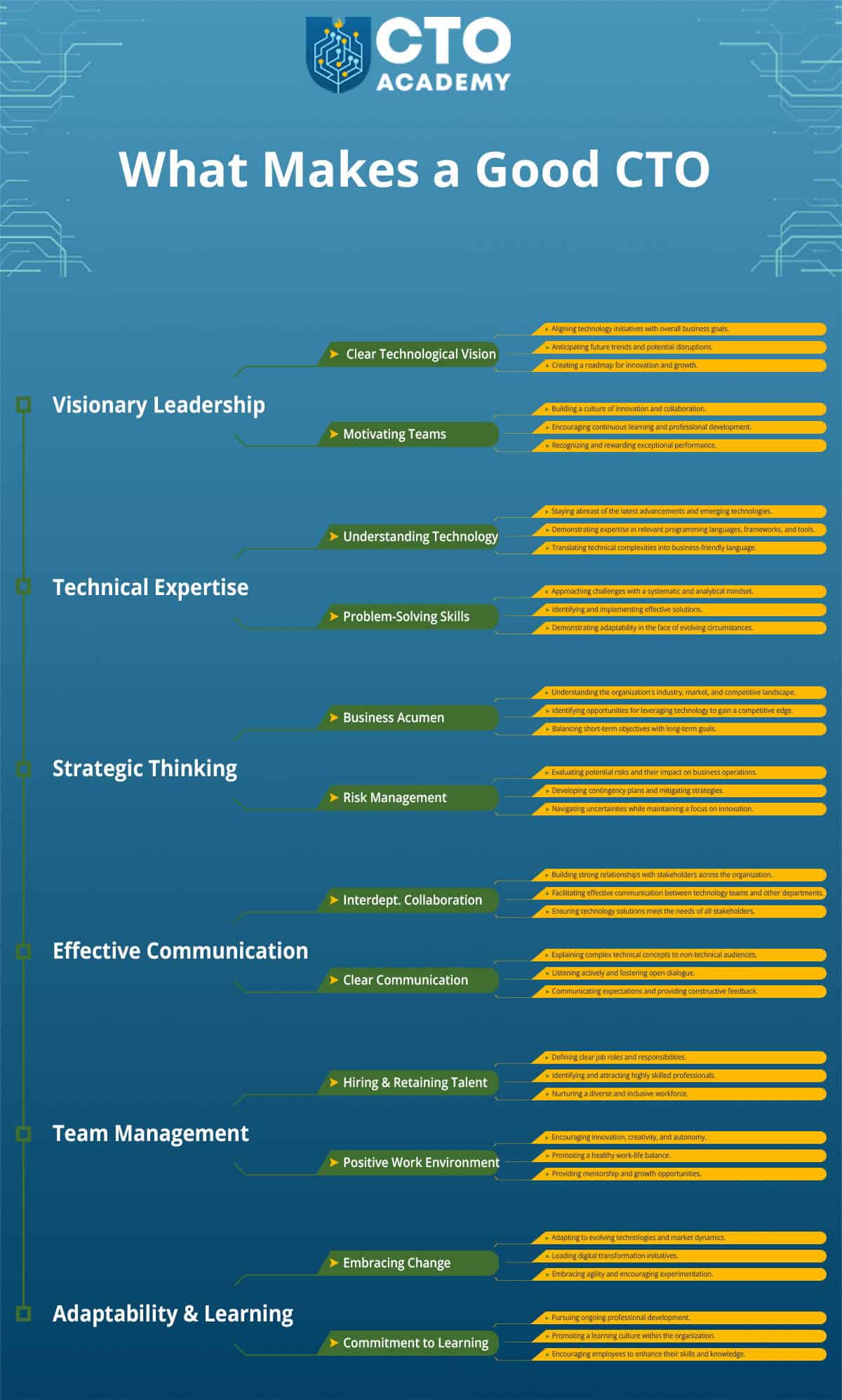
What makes a good CTO summary (click to enlarge/download)
1. Visionary Leadership
Setting a Clear Technological Vision
In other words:
Aligning technology initiatives with overall business goals.
Anticipating future trends and potential disruptions.
Creating a roadmap for innovation and growth.
That said, there are two serious challenges that can arise when trying to establish a clear technological vision.
#1: Balancing Short-Term Needs with Long-Term Goals
How do you strike the right balance between short-term needs and long-term goals when setting a technological vision?
While addressing immediate operational requirements is important, it is equally crucial to consider the organisation’s long-term objectives and the potential impact of technological decisions.
This challenge involves evaluating trade-offs, considering scalability and anticipating future needs. All of this is critical to ensure the technological vision remains relevant and, more importantly, aligned with the organisation’s strategic direction.
#2: Navigating Complexity and Uncertainty of the Tech Landscape
To make such a decision, you must assess the risks associated with implementing new technologies, consider the potential impact on existing systems and processes, and evaluate the feasibility and compatibility of various options.
However, external factors such as market trends, regulatory changes and customer demands add to this complexity and uncertainty, making it challenging to set a clear technological vision.
How do you address these challenges?
It requires a proactive approach, strategic thinking and collaboration with key organisational stakeholders. In other words, chief technology officers need to continuously gather market intelligence, leverage industry networks and foster an environment that encourages experimentation and innovation.
Hence, by staying informed, maintaining a long-term perspective and embracing flexibility, a great CTO can overcome these challenges and establish a clear technological vision that drives organisational success.
Inspiring and Motivating Teams
In short:
Building a culture of innovation and collaboration.
Encouraging continuous learning and professional development.
Recognizing and rewarding exceptional performance.
Sounds simple enough, doesn’t it? I mean, inspiring and motivating teams is a crucial aspect of effective leadership and team management. Everybody knows that.
But what you might be unaware of are challenges that often arise when trying to achieve this. Moreover, you might not know how to address them. What makes a good CTO is exactly that – knowing how to address the challenge when it emerges.
You must, for example, manage diverse skill sets and perspectives.
As you know, tech teams typically consist of individuals with diverse skill sets, backgrounds and perspectives. This diversity can lead to challenges in aligning team members towards a common vision and fostering collaboration. Moreover, different team members may have varying levels of motivation and engagement.
So how do you deal with this?
You start with promoting a culture of inclusivity and respect, valuing and appreciating each team member’s contributions.
Then, you create a strategy of providing opportunities for professional growth and development, tailored to individual interests and aspirations.
Finally, you keep encouraging cross-functional collaboration and knowledge sharing. You want to do this to leverage diverse perspectives and foster a sense of unity within the team. Because where everybody thinks the same, nobody’s thinking.
What about inevitable burnout and dealing with workload pressures?
How do you deal with that elephant?
We all felt it. We all struggled with it. Long hours, tight deadlines and high expectations can easily affect morale and motivation.
And this right here is what separates excellent CTOs from mediocre ones. The former are aware that the only way they’ll do their job successfully is by having a lean team that handles pressure with ease.
So how do they ensure such a high level of resistance to the plague of engineering teams?
They start by promoting optimal work-life balance. This means encouraging employees to take regular breaks and recharge. And that implies constant monitoring of every team member!
To keep everybody highly motivated, they practice recognising and rewarding team members’ efforts and achievements. In other words, praise them to activate the serotonin activation. High activation of this hormone in the brain is what makes you proud of yourself!
But none of it would work if there were no effective workload management strategies, such as resource allocation and prioritisation. This is what prevents burnout and ensures a sustainable work environment.
And when you successfully address all the aforementioned challenges, you still need to
Foster innovation and boost creativity.
To some CTOs, this is a severe obstacle and it can bring the whole organisation to a standstill.
Luckily, there are a few things you can do.
First and foremost, you should strive to create a culture that encourages experimentation and risk-taking. In such a culture, failure is an opportunity for learning and not a reason to fire someone.
Then you need to provide a safe and supportive environment for sharing ideas and constructive feedback. In other words, everybody has a say and everybody can challenge the idea or concept!
But to even get those concepts and ideas, you must allocate dedicated time and resources for innovation projects, hackathons or research and development initiatives. This will stimulate creativity and foster a spirit of innovation within the team.
(Technology trends and proper time management come to mind, don’t they?)
Additionally, a great CTO recognizes the importance of
Effective communication and transparency.
To be as efficient as possible, team members must understand the purpose and significance of their work. Thus, there has to be clarity on goals, expectations and progress.
Regular communication, such as team meetings, one-on-one sessions and progress updates, enable the CTO to address any concerns or challenges promptly and maintain an open dialogue. In turn, that same CTO has a team that is famous for its productivity, innovation and overall team satisfaction (like our CTO, Jason, here at the Academy, for instance :).
2. Technical Expertise
Deep Understanding of Technology
That is:
Staying abreast of the latest advancements and emerging technologies.
Demonstrating expertise in relevant programming languages, frameworks and tools.
Translating technical complexities into business-friendly language.
While the first bullet point is somewhat of a common sense, you might be wondering why is demonstrating expertise so important when everybody’s saying that technical leaders need soft skills more than they need technical skills. Why is software development skill, for instance, suddenly on the list?
You also want to be constantly aware of every available tool so you wouldn’t waste the company’s money and team time on something that’s already built.
The third bullet point is tricky. You see, one of the management skills of every CTO is the ability to translate the often complicated tech jargon to a non-technical stakeholder or customer.
Take board meetings for instance. There are people in there who simply don’t know what, for example, Schnorr Signature is. You can’t exactly draw a diagram on the whiteboard, but you can say that you’ve chosen the simplest yet most effective encryption model that is also light and highly reliable.
Problem-Solving Skills
This means:
Approaching challenges with a systematic and analytical mindset.
Identifying and implementing effective solutions.
Demonstrating adaptability in the face of evolving circumstances.
Is there a way for you to further sharpen your problem-solving skills? Or to develop adaptability in this constantly evolving industry?
This problem can be compartmentalised into three individual groups, each with its own respective action steps:
#1: Continuous Learning and Professional Development
Attend industry conferences, seminars and workshops to stay updated on emerging trends and technologies.
Pursue relevant certifications or advanced degrees to deepen technical knowledge and problem-solving abilities.
Engage in self-study through books, online courses or tutorials focused on problem-solving techniques and methodologies.
#2: Embrace Collaborative Problem-Solving
Encourage cross-functional collaboration; in other words, bring together individuals with diverse perspectives and expertise to tackle complex problems.
Implement brainstorming sessions or design thinking workshops to promote creative problem-solving and generate innovative ideas.
Facilitate effective communication channels and create an environment where individuals feel comfortable sharing their insights and perspectives.
Collaborative problem-solving allows you to leverage the collective intelligence of your teams and, thus, generate well-rounded solutions to complex challenges.
Six Sigma or Lean methodologies. These provide a data-driven approach to problem-solving and process improvement.
But the most important thing to remember is that problem-solving skills are honed through practical application.
3. Strategic Thinking
Business Acumen
Understanding the organisation’s industry, market and competitive landscape.
Identifying opportunities for leveraging technology to gain a competitive edge.
While you can learn about the industry and market relatively easily, identifying opportunities, on the other hand, can be a much tougher nugget.
So here are a few key steps you can take to identify these opportunities:
#1: Stay Abreast of the Technological Landscape
Regularly monitor industry publications, research papers and technology news sources.
Participate in relevant conferences, seminars and webinars.
Engage with professional networks and communities to share insights and learn from peers.
#2: Conduct Market and Competitor Analysis
Conduct market research to understand customer needs, industry trends and market dynamics.
Assess the competitive landscape to identify gaps and areas where technology can differentiate the organisation.
Analyse the technological strategies and initiatives of competitors to identify potential opportunities or areas for improvement.
#3: Collaborate with Business Stakeholders
Engage with business leaders, executives and other key stakeholders to understand their goals and challenges.
Participate in strategic planning sessions to align technology initiatives with the business strategy.
Seek input and feedback from stakeholders to identify pain points and areas where technology can provide solutions.
#4: Foster Innovation and Ideation
Create an environment where employees are encouraged to share ideas and explore innovative solutions.
Implement mechanisms such as innovation labs, hackathons or idea-generation sessions to foster creative thinking.
Provide resources and support for employees to prototype and test new ideas.
#5: Leverage Data and Analytics
You do this by:
Implementing robust data analytics capabilities (to gain insights into customer behaviour, market trends and operational efficiency).
Using predictive analytics and machine learning algorithms (to identify patterns and anticipate future opportunities).
Applying business intelligence tools (to analyse data and identify areas where technology can drive improvements or innovation).
In the end, don’t forget to continually assess and refine the technology strategy to align with changing market dynamics and organisational goals. Because tomorrow will inevitably bring something new.
Risk Management
The CTO role, be it a startup CTO or a tech leader in a fast-growing organisation, involves risk management. And that part of the role comes down to:
Evaluating potential risks and their impact on business operations.
Developing contingency plans and mitigating strategies.
Navigating uncertainties while maintaining a focus on innovation.
Now, while you may have experience with the first two, what about the last one? How do you balance risk management with innovation?
Here are three proven strategies:
Conducting risk assessments to identify potential challenges and develop mitigation strategies.
Establishing clear risk tolerance levels and guidelines to guide decision-making.
Encouraging calculated risk-taking by assessing potential benefits against potential risks.
Additionally, you should embrace agile approaches, foster experimentation, stay informed about technological trends and promote collaboration and open communication. That’s how you balance the two.
4. Effective Communication
There’s already a lot of talk about communication so we’ll keep this part short and to the point. It comes down to two main categories:
#1: Interdepartmental Collaboration or Organisational
Building strong relationships with stakeholders across the organisation.
Facilitating effective communication between technology teams and other departments.
Ensuring technology solutions meet the needs of all stakeholders.
#2: Clear and Concise Communication or Interpersonal
Explaining complex technical concepts to non-technical audiences.
Listening actively and fostering open dialogue.
Communicating expectations and providing constructive feedback.
Moving on to
5. Team Building and Management
One of your responsibilities as a technology leader is ensuring that your teams are highly productive, adaptive and, more importantly, resilient. There are two things you need to pay special attention to to keep them on such a level:
#1: Hiring and Retaining Top Talent
The first job is to define job roles and responsibilities. The former helps you search for the right type of talent and the latter helps that talent understand his or her purpose.
Then you need to create a stimulating environment that will attract highly skilled professionals. Lately, this is done by nurturing a diverse and, most importantly, inclusive workforce/culture. You see, money, while bearing much importance in the decision-making process, is often not the decisive argument. Sometimes, a positive atmosphere and an incentivising environment mean much more.
Hence, the second thing.
#2: Cultivating a Positive Work Environment
In other words:
Encouraging innovation, creativity and autonomy.
Promoting a healthy work-life balance.
Providing mentorship and growth opportunities.
6. Adaptability and Continuous Learning
What Makes a Good CTO is the Ability to Embrace Change
The high level of adaptability is best seen in tech leaders who are:
Adapting to evolving technologies and market dynamics timely and with ease
Leading digital transformation initiatives
Embracing agility and
Encouraging experimentation
Experimentation in particular is pivotal for adaptability because it fosters innovation, facilitates learning and insight generation, mitigates risks, promotes agility and adaptability and drives continuous improvement. Hence, by embracing experimentation as a core practice, CTOs can navigate uncertainties, respond effectively to evolving technologies and market dynamics and position their organisations for long-term success.
And the Commitment to Learning
This spans beyond the CTO and involves a wider organisation. You want everybody on the mission of:
Pursuing ongoing professional development and
Promoting a learning culture within the organisation
The best way to achieve this is to encourage employees to enhance their skills and knowledge. In other words, everybody learns and develops, not just you!
Conclusion
As you can see, being a successful chief technology officer requires a unique blend of technical expertise, strategic thinking, leadership abilities and effective communication skills. By embodying the qualities discussed in this blog post, technology leaders can drive innovation, foster collaboration and navigate the complex landscape of modern business.
Whether you are an existing CTO or aspire to become one, cultivating these qualities will position you as an influential force in shaping the future of technology-driven organisations.
With our guidance, you will excel in every aspect of your professional and personal life. Over 7,500 individual lecture ratings of our Digital MBA for Technology Leaders and the average rating of 4.7/5 serve as proof.
Unprecedented advances and transformative trends are reshaping leadership in technology sector. As the rapid pace of technological innovation continues, the tech industry faces unique challenges and opportunities. The intersection of artificial intelligence, automation and data-driven insights demands visionaries who can effectively navigate this complex landscape.
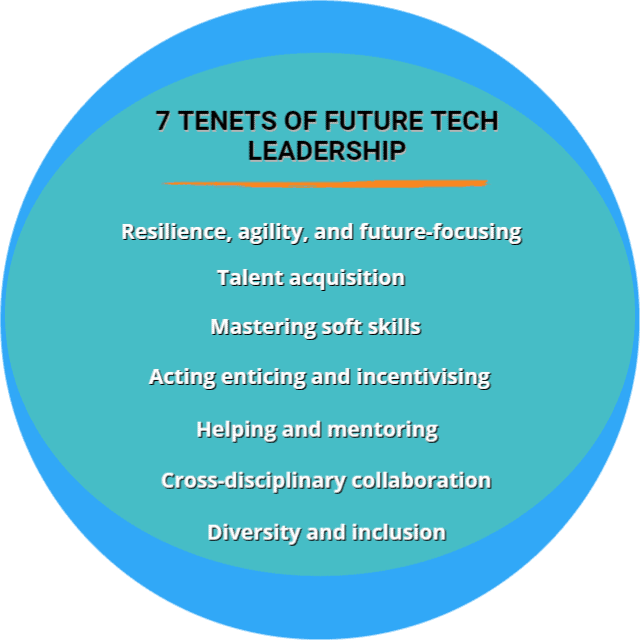
Resilient, agile and future-focusing executives will be instrumental in driving digital transformation, fostering innovation and harnessing the potential of emerging technologies. As organizations strive to remain competitive, leaders must possess a deep understanding of the evolving technological landscape coupled with strategic thinking and adaptability.
Furthermore, ethical considerations, diversity and inclusion and the ability to effectively manage and inspire teams in a remote and globalized work environment are becoming increasingly crucial.
In this report, we discuss the most significant drivers of the change while providing actionable steps that will help steer you through this rapidly evolving environment.
Emerging technologies and their impact on tech leadership
Artificial intelligence, blockchain, the Internet of Things, and augmented reality are disrupting industries, revolutionizing processes, and redefining business models. The ability of technology leadership to understand and harness the power of these technologies will be critical for success.
To thrive in this dynamic environment, chief technology officers can take several steps:
Stay informed: In other words, stay updated on the latest trends and advances in emerging technologies through industry publications, conferences and online resources.
Embrace lifelong learning: Develop a growth mindset and actively seek opportunities to acquire new skills and knowledge related to emerging technologies.
Foster collaboration: That is, build networks and collaborate with experts and peers in the technology field to exchange ideas, share insights and stay at the forefront of emerging technology developments.
Experiment and innovate: Encourage creative problem-solving to explore the potential applications of emerging technologies.
Develop adaptability: Being adaptive and flexible enables a quick response to the evolving landscape and the ability to embrace new opportunities as they arise.
Adaptive leadership in the era of technological advancements
Adaptive leadership is, effectively, the ability to anticipate, embrace, and respond effectively to changes brought about by technology.
This is achieved by cultivating a mindset that values learning and embraces challenges. In a nutshell, that means that you see setbacks as opportunities for growth and seek feedback to continuously improve your skills and knowledge.
The opportunities mostly arise as a result of fostering a culture of innovation. In other words, encourage experimentation, creativity and open exchange of ideas within your team or organization. Most importantly, create a safe space for taking calculated risks and motivate your engineers to really think outside the box.
You should also make every effort to develop cross-functional expertise. Expand your knowledge beyond your specific domain by developing a broad understanding of various technologies, industry trends and market dynamics. This interdisciplinary approach will enable you to adapt more effectively to new challenges and identify opportunities.
Years of free money and an almost frantic pursuit of growth are now over. VCs and Wall Street are now focusing on profitability and sustainability which, for those fresh in their leadership roles, means playing a whole new type of game. Being a cross-disciplinary expert will help steer you through this new environment.
AI and automation: reshaping the role of leadership in technology sector
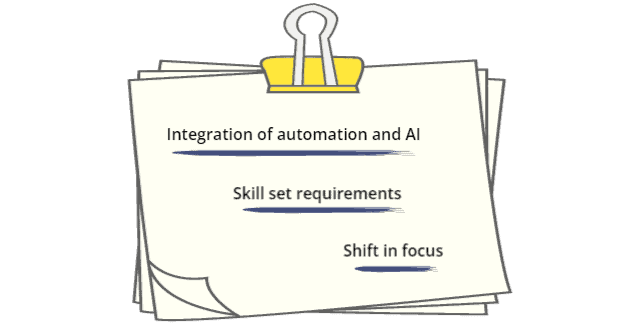
Increasing integration of automation and AI lately
This integration has enabled organizations to automate repetitive tasks, improve operational efficiency, and enhance decision-making processes. Consequently, it is forcing CTOs to understand and leverage these technologies effectively.
Evolving skill set requirements
We are talking about a deep understanding of AI algorithms, data analysis, machine learning, and emerging technologies to drive innovation and make strategic decisions.
Shift in focus
Chief technology officers are now shifting their focus from overseeing manual processes to leading and managing AI and automation initiatives. This includes identifying opportunities for implementation, ensuring the ethical use of AI, and fostering a culture of innovation.
Significant consequences of this reshaping
Tech leaders who fail to adapt may risk becoming obsolete or face challenges in effectively leading their teams. On the other hand, embracing the reshaped role can yield benefits such as improved operational efficiency, enhanced decision-making, and increased innovation.
Increasing integration of automation and AI
This integration has enabled organizations to automate repetitive tasks, improve operational efficiency and enhance decision-making processes. Consequently, it is forcing CTOs to understand and leverage these technologies effectively.
Evolving skill set requirements
We are talking about a deep understanding of AI algorithms, data analysis, machine learning and emerging technologies to drive innovation and make strategic decisions.
Shift in focus
Chief technology officers are now shifting their focus from overseeing manual processes to leading and managing AI and automation initiatives. This includes identifying opportunities for implementation, ensuring the ethical use of AI and fostering a culture of innovation.
Significant consequences of this reshaping
Tech leaders who fail to adapt may risk becoming obsolete or face challenges in effectively leading their teams. On the other hand, embracing the reshaped role can yield benefits such as improved operational efficiency, enhanced decision-making and increased innovation.
To adjust, consider these steps:
Invest in continuous learning to stay updated and develop a deep understanding of these technologies and their potential impact on the organisation.
Encourage cross-functional collaboration between tech teams, data scientists and business units to drive innovation and leverage AI and automation effectively.
Cultivate adaptability and experimentation as two keys in navigating the evolving technology landscape.
Develop ethical awareness to a) understand the ethical implications of AI and automation, and b) ensure that the use of these technologies aligns with ethical standards. In short, prioritize transparency, fairness and accountability in decision-making processes.
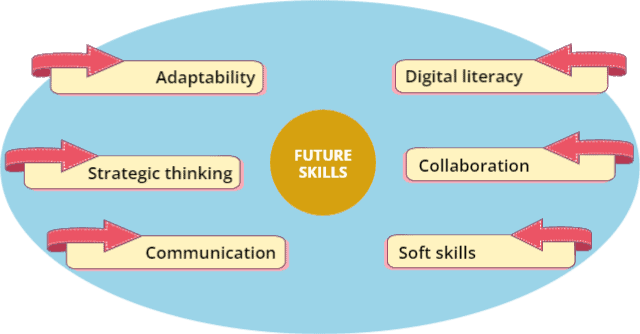
Future skills that enable navigation through disruptive innovation
These skills encompass a range of competencies, including:
Adaptability: i.e.embracing change, quickly learning new technologies, and adapting strategies to navigate disruptive innovation effectively.
Digital literacy to develop a deep understanding of emerging technologies such as artificial intelligence, blockchain, and data analytics. This, in turn, will enable you to make informed decisions and drive innovation.
Strategic thinking or the capacity to envision long-term goals, identify opportunities for growth and competitive advantage and develop strategies to capitalize on disruptive trends.
Collaboration and Communication to enhance cross-functional teamwork, bridge gaps between technical and non-technical stakeholders and facilitate innovation.
To speed up the acquisition of these vital skills, you can employ several strategies:
Continuous learning: Engage in self-study, online courses, workshops, and industry events to stay updated on the latest technologies and trends.
Mentoring and networking: Seek guidance from experienced tech leaders and build a strong professional network to gain insights and learn from their experiences.
Hands-on experience: Engage in practical projects and initiatives, experimenting with emerging technologies to gain first-hand experience and develop problem-solving skills.
Industry collaboration: Collaborate with industry partners, start-ups, and academic institutions to gain exposure to real-world challenges and innovative practices.
Personal development: Enhance communication, leadership and emotional intelligence skills through coaching, personal development programs and self-reflection.
Equipped with these competencies, you can lead your team and organization to embrace emerging technologies, seize opportunities and drive sustainable growth in the dynamic technology landscape.
Digital transformation and the evolution of tech leadership
One of the primary challenges is the need to balance traditional IT responsibilities with driving innovation and strategic decision-making. CTOs must shift their focus from purely technical expertise to understanding the broader business implications of digital transformation. In other words, you need to align technology initiatives with organizational goals, collaborate with cross-functional teams and drive cultural change.
It is, basically, a shift from a purely technical role to that of a strategic business partner. You, therefore, must understand emerging technologies, data analytics, customer-centricity and digital trends.
The fastest way for you to adjust to this evolution involves:
Seeking mentorship or guidance from experienced chief technology officers who can provide valuable insights and support during the adjustment process
This way, you are becoming instrumental in driving digital transformation initiatives, guiding your organisation through technological disruptions and positioning yourself as a strategic leader who can effectively leverage technology to achieve business objectives.
Ethical considerations in leading AI and data-driven technologies
Several capital risks arise in this domain:
Privacy and data security
The collection and use of vast amounts of personal data can pose privacy and security risks. Solutions include:
Implementing robust encryption measures
Anonymizing data whenever possible
Ensuring compliance with data protection regulations
Bias and fairness
Addressing this risk involves:
Regularly auditing AI systems for bias
Diversifying data sources
Incorporating fairness metrics into the development process
Accountability and transparency
The opacity of AI systems can make it difficult to understand and explain their decisions. You can mitigate this risk by:
Adopting explainable AI techniques
Maintaining transparency in data usage policies
Establishing clear lines of responsibility and accountability
Job displacement and workforce impact
The automation enabled by AI can lead to job displacement and social implications. To prevent negative impacts:
Invest in retraining programs
Promote a culture of lifelong learning
Foster collaboration between humans and AI because we are becoming increasingly addicted to tech-facilitated human interaction
Ethical decision-making
The three biggest challenges in leading AI and data-driven technologies right now are:
Ensuring ethical governance (i.e. establishing ethical guidelines and frameworks to govern the development and deployment of AI systems)
Ethical use of data (i.e. addressing concerns related to data privacy, consent, and responsible data sharing)
Addressing algorithmic bias (i.e. mitigating bias in AI algorithms to ensure fairness and prevent discrimination)
The question is, how do you address these three challenges in an optimal way?
There are four initiatives that you can employ almost immediately:
Develop ethical AI policies: In other words, establish clear guidelines and principles that outline ethical expectations and considerations in AI development and deployment.
Encourage diversity and inclusion: Diverse teams have a range of perspectives that, when approached analytically, effectively mitigate biases and promote fairness.
Promote ethical awareness and education: That is, provide training and resources to educate employees and stakeholders about ethical considerations and responsible AI practices.
Engage in public dialogue: This implies active participation in discussions and collaboration with stakeholders, policymakers and the public to address concerns and shape responsible AI policies and regulations.
Building resilient tech executives for an uncertain future
Technological advancements, market conditions and business landscapes are constantly changing, making it challenging to predict outcomes and plan with certainty.
Consequently, a CTO must adapt, persevere and lead effectively in the face of ambiguity and change.
Therefore, to best prepare for uncertainty, consider taking the following steps:
Embrace a proactive mindset to regard change as an opportunity rather than a threat, remaining agile and adaptable.
Foster scenario planning to explore possible outcomes and develop strategies to respond to each possibility.
Encourage continuous learning to stay updated on emerging technologies, industry trends and market dynamics and, thus, make informed decisions and identify new opportunities.
Cultivate a culture of innovation that encourages creativity, experimentation and the exploration of new ideas. This mindset helps tech executives and their teams to stay ahead of the curve and adapt to emerging trends.
Develop strategic partnerships. That is to say, collaborate with external partners, start-ups, and industry experts to gain insights, share knowledge and leverage collective intelligence.
When we observe this challenge from the perspective of the technology industry as a whole, the process of building resilient tech leaders implies:
Cultivating a culture that encourages continuous learning, experimentation, and embracing failures as opportunities for growth.
Developing emotional intelligence which equips tech executives with the skills to understand and manage their own emotions, as well as effectively navigate interpersonal dynamics (i.e. building strong relationships, motivating teams and handling stressful situations with resilience).
Encouraging collaboration and networking on a global scale. The key outcome is resilience through shared experiences and collective problem-solving.
Arming leaders with change management skills (i.e. providing training in change management methodologies and encouraging a flexible and agile mindset).
Now, while it may not be possible to turn the unknown into the known completely, technology leaders can reduce uncertainty by engaging in market research, customer feedback and industry analysis. Cumulatively, this approach provides valuable insights to inform strategic planning and reduce uncertainty to an acceptable degree.
Conclusion
Leadership in technology sector is evolving rapidly, driven by factors such as emerging technologies, digital transformation and the need for ethical considerations. To thrive in this dynamic landscape, future leaders must adapt and develop the necessary skills and mindset.
In a nutshell, there are 7 tenets — the 7 key takeaways — of future leadership in the tech industry:
Resilience, agility, and future-focusing (i.e. data-driven cognitive leadership that employs analytical tools, AI and ERP; system thinking; operational functioning and innovation through actionable data)
Acting enticing and incentivising (to empower autonomy!)
Helping and mentoring (to align the right people with the right tools!)
Cross-disciplinary collaboration
Making diversity and inclusion the way of life
By adopting these seven tenets, aspiring and current tech leaders can position themselves as effective leaders in the tech sector. They will be well-equipped to navigate disruptive innovations, foster innovation and lead their teams and organizations towards success in an ever-changing landscape.
“I have a habit of completing other people’s sentences for them …. Is that a problem?”
Was a question pitched to me during one recent leadership coaching session
Rather inevitably my coachee then decided to interrupt before I could finish my response …
Whilst it was a mildly amusing moment we both recognised, my recognition was partly introspective on the basis that a leadership skill I had to develop over time was the art of deep listening.
That’s because in the disappointingly short list of my leadership qualities at the time … Deep listening wasn’t near the top
I wouldn’t say that I’ve since cracked the skill completely But I’ve seen it’s important role for any effective leader.
“By maintaining good eye contact, you are demonstrating to your conversation partner that you are fully engaged and interested in what he or she is saying. A good guideline to follow is the 80/20 rule, in which 80% of the time your eyes are meeting your speaking partner’s, and 20% of the time, your eyes are roaming as you gather information to say.”
PRESENCE
“The average person speaks between 135 and 160 words per minute, but the average person’s brain works between 400 and 600 words per minute. This means your mind is going a lot faster than your conversation partner’s mouth, which makes it easy for your mind to drift. It’s up to you to stop your mind from shifting away from the conversation and to be truly present. Not only will you be able to fully absorb what your partner says, you will be able to respond in kind, which makes them feel appreciated and understood.”
NONVERBAL FEEDBACK
“There’s nothing worse than speaking to someone who gives no verbal feedback. It’s like talking to a wall. Make the effort to give the occasional nod, smile, or other sign of recognition to your conversation partner. These nonverbal cues may seem trivial, but have tremendous impact by showing your interest, understanding and involvement in the conversation.”
CONNECTION
“When you are speaking one-on-one with someone, position your body in a way that creates a safe and welcoming space for him or her to speak openly. Lean slightly in, open up your chest, pull your shoulders back, and fold your hands gently in your lap or on the table in front of you. If you are standing, form a reversed hand steeple, in which the fingers come together to form a point. When someone steeples in the lap area, it means they are confident about what they are hearing.”
“There’s a principle I like that comes from the Zulu people, where instead of saying ‘hello’ at the start of a conversation, they say ‘sawubona’.
This roughly translates to ‘I see you’ …
It’s about taking a specific moment before they engage in dialogue to recognise that the other person has their own thoughts and perceptions, their own values and experience, and that whatever they say is important to them.
It’s recognising the validity of them as a person, that you’ve come together to share perspectives, and the conversation can only be truly meaningful if we approach it with that level of respect for each other”
How gorgeous is that?
Pack Sawubona into your leadership toolkit and you won’t go far wrong.